In This Article
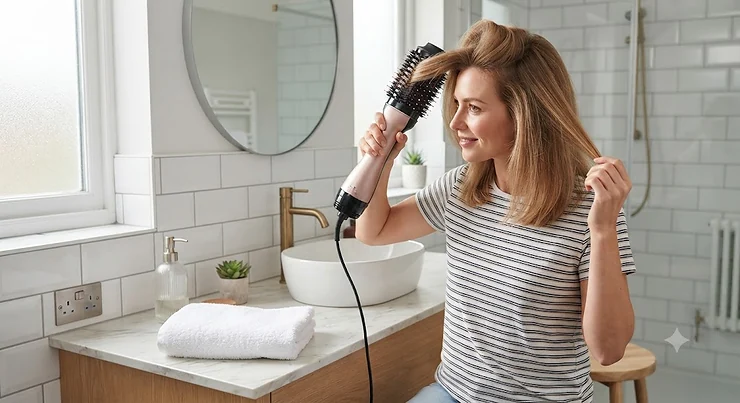
Fine hair has a cruel sense of humour. It goes flat by lunchtime, it frizzes the second the British weather turns damp, and it seems to sunburn under heat that thicker hair would barely notice. So if you’ve been hunting for a hot air brush for fine hair and quietly dreading another dud purchase, you’re in good company — this is one of the most searched-for, most argued-about categories in the whole haircare aisle. The honest truth is that most hot air brushes are designed with an “all hair types” label slapped on, when in reality fine and thin strands need lower wattage, gentler bristle tension and proper temperature control, or they end up dry, static and worse off than before.
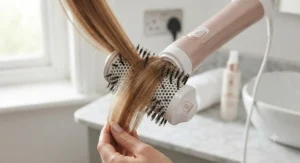
A hot air brush is a two-in-one styling tool that combines a round brush barrel with a built-in hairdryer motor, so you dry and shape your hair in a single pass instead of drying first and then curling separately. For fine hair specifically, the ones worth owning bring lower default heat, lighter barrels that don’t strain thin strands mid-style, and enough control to add lift at the root without cooking the mid-lengths. It’s worth grounding all of this in the basics first — NHS Gloucestershire’s hair care guidance is a genuinely useful starting point on how heat interacts with hair generally, before we get into which specific tools handle that interaction best. Over the course of this guide, we’ve pulled apart the specs, cross-referenced aggregated customer sentiment, and lined up seven real, currently available options against each other — budget, mid-range and proper investment pieces — so that by the end you’ll know exactly which one deserves a spot on your bathroom shelf.
Quick Comparison Table
Before we get into the weeds, here’s the shorthand version. Every price below is a range, because Amazon pricing shifts constantly — always check current pricing before you commit.
| Brush | Barrel Size | Heat Control | Best For | Price Range |
|---|---|---|---|---|
| Remington Blow Dry & Style Caring Airstyler | 25mm & 38mm | 2 heat settings | Budget first-timers | Under £45 |
| BaByliss Big Hair Petite Rotating Styler | 32mm | 2 speeds | Short-to-mid fine hair | £35-£45 range |
| Revlon One-Step Volumizer Plus 2.0 | 2.8″ oval | 3 heat settings | Fast everyday volume | £50-£65 range |
| Beauty Works XXL Volume Hot Brush | 38mm | Digital, 80-220°C | Precise heat dialling | £70-£100 range |
| Cloud Nine Original Hot Brush | Ceramic barrel | 5 settings, 110-190°C | Fragile/damaged fine hair | £100-£140 range |
| ghd Duet Blowdry | Elliptical barrel | Fixed low 120°C | Daily use, minimal damage | Around £380 |
| Dyson Airwrap i.d. Multi-Styler | Interchangeable barrels | Coanda airflow, no extreme heat | Multi-styler investment | £400-£480 range |
Looking at the spread here, there’s a clear pattern: the further up the price ladder you go, the more precisely each tool can be tuned to fine hair’s low heat tolerance, whether that’s the Beauty Works XXL Volume Hot Brush‘s digital dial or the ghd Duet Blowdry‘s fixed, sensor-monitored 120°C. But that doesn’t mean the budget end is a write-off — the Remington Blow Dry & Style Caring Airstyler and BaByliss Big Hair Petite Rotating Styler both include a genuinely low heat setting, they’re just less precise about holding it steady. If your hair is fine but otherwise healthy, mid-range is usually the sweet spot; if it’s fine and already compromised by colour or heat history, the extra control up top starts to earn its price tag.
💬 Found a pick you’re already leaning towards? Scroll down for the full breakdown before you decide!
Top 7 Hot Air Brushes for Fine Hair: Expert Analysis
1. Revlon One-Step Volumizer Plus 2.0 — best all-rounder for everyday volume
The updated Plus 2.0 keeps the oval-barrel mechanism that made the original a bestseller, but sharpens the heat distribution and softens the grip, which matters more than it sounds for fine hair sessions that can run ten minutes or longer. The barrel’s oval shape does two jobs at once: the flatter side smooths, the rounder side adds lift, so one pass through can do what used to take a dryer and a separate round brush. Based on the spec comparison, the 1100W motor sits right in the zone fine hair actually wants — enough airflow to dry quickly, not so much that it strips moisture the way 1800W-plus tools can. The brand’s own instructions recommend the low setting specifically for fine hair, which is a rare bit of honesty from a manufacturer that could just as easily have buried that detail. What most buyers overlook is that the nylon-and-boar bristle blend is doing real detangling work as you style, reducing the number of passes needed — and fewer passes means less cumulative heat exposure. Reviewers consistently report that the tool’s biggest strength is speed rather than longevity of curl; the volume is real but tends to soften by evening, which tracks with how fine hair generally holds a style. A common complaint in user reviews is that the barrel runs hot to the touch near the base, so a heatproof mat is worth the extra fiver.
Pros:
- ✅ Genuine low-heat setting built specifically for fine hair
- ✅ Detangling bristles cut down on repeated heat passes
- ✅ Fast drying time keeps total heat exposure low
Cons:
- ❌ Curl and volume relax faster than pricier alternatives
- ❌ Barrel base gets noticeably hot during longer sessions
Sitting in the £50-£65 range, this is solid value if you want daily reliability without a big outlay — the trade-off is longevity of style rather than gentleness on the hair itself.
2. BaByliss Big Hair Petite Rotating Styler — lightest handle for short-to-mid fine hair
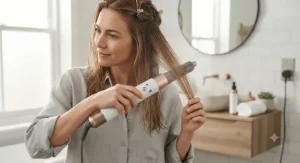
This is the smaller-barrelled sibling of BaByliss’s original Big Hair range, built with a 32mm rotating head that’s genuinely lighter to hold than most hot air brushes on this list — a meaningful detail when you’re one-handed styling near your scalp for several minutes. The rotating mechanism does the twisting for you via two directional buttons, which takes real pressure off wrists and, indirectly, off hair that would otherwise get yanked while you manually turn a static barrel. On paper this means less mechanical stress at the follicle, something that matters as much as heat when we’re talking fine hair heat damage prevention. BaByliss’s own hair care guidance for this range explicitly recommends the lower heat setting for delicate, fine, bleached or coloured hair, which lines up with what reviewers report: several note using it exclusively on the low setting and still getting noticeable root lift. Here’s what to weigh though — the smaller 32mm barrel that makes it light and manoeuvrable also means it isn’t built for longer hair; if your fine hair sits past your shoulders, the wrap-around styling technique the brand suggests simply won’t fit as much hair per pass, so you’ll be sectioning more finely and spending longer under heat overall.
Pros:
- ✅ Noticeably lighter barrel reduces wrist and root strain
- ✅ Auto-rotating action needs less manual heat-pass repetition
- ✅ Manufacturer-recommended low setting for delicate hair
Cons:
- ❌ Barrel size limits it to short or mid-length fine hair
- ❌ Some users report a stiffer wrap feel than the larger original
At around £35-£45, this is arguably the best-value lightweight brush barrel option here, provided your length works with the smaller head.
3. Remington Blow Dry & Style Caring Airstyler — best budget entry point
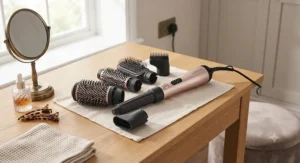
Remington’s Caring range leans hard into the idea that “caring” means lower default heat, and the spec sheet backs it up: this is a genuinely restrained motor compared to salon-grade tools, paired with two heat and two speed settings rather than the aggressive three-tier setups seen on pricier brushes. Reviewers consistently note the trade-off is honest — one commonly cited comment mentions it not being powerful enough for thick or coarse hair, which is precisely the flip side of it being gentle enough for fine, limp strands. The six-piece attachment set (a firm paddle, three ceramic-coated bristle brushes in different sizes, a concentrator nozzle and a root-boost tool) means you’re not locked into one barrel size, which is genuinely useful for fine hair that changes texture between root and tip. Based on the spec comparison against the other budget option here, the swivel cord and lightweight body make it comfortable for longer sessions, which matters because the lower wattage means you’ll likely need a touch more time per section than with the punchier mid-range tools. What the spec sheet won’t tell you, but user reports suggest, is that partly-dried hair gives noticeably better results than fully wet hair — starting damp rather than soaking cuts your total heat-exposure time considerably.
Pros:
- ✅ Genuinely low-power motor designed to avoid thermal damage
- ✅ Six attachments cover root lift, curls and smoothing
- ✅ Swivel cord and light body suit longer, gentler sessions
Cons:
- ❌ Underpowered for thick, coarse or very long hair
- ❌ Takes longer per section than higher-wattage rivals
Priced under £45, it’s the safest entry-level pick if your priority is a hot air brush that doesn’t damage fine hair over one that finishes fastest.
4. Beauty Works XXL Volume Hot Brush — best precise heat control for the money
This is where things get genuinely useful for fine hair specifically: a digital temperature dial running from 80°C right up to 220°C, displayed on an LCD screen, so instead of guessing between “low” and “high” you can sit somewhere in the 110-130°C zone that most trichologists would consider the safer end of styling heat. The 38mm barrel is on the longer side, which speeds up styling on mid-to-long fine hair by covering more strands per pass — fewer passes again means less cumulative heat contact. Four ion generators pushing out what the brand states as up to five million negative ions are there to counteract the static and flyaways that plague fine hair more than any other type, since finer strands carry less natural weight to hold frizz down. Reviewers who tested it against bulkier hot brushes specifically flagged the sturdiness of the build and the flexible bristles gliding through hair without snagging, which for fine hair prone to breakage at the point of friction is a genuinely important detail most spec sheets gloss over. It isn’t a wet-to-dry tool, so you’ll need to rough-dry first, which does add a step compared with the ghd below — but that pre-drying stage actually gives you more control over exactly how much residual dampness the hot brush is working with.
Pros:
- ✅ Genuinely adjustable digital heat from 80°C to 220°C
- ✅ Ionic technology tackles fine-hair static and flyaways
- ✅ Automatic 30-minute shut-off for peace of mind
Cons:
- ❌ Requires pre-drying rather than working from soaking wet
- ❌ Longer 38mm barrel needs a slightly bigger sectioning technique
In the £70-£100 range, this is the pick for anyone who wants a genuinely low heat hot air brush without paying premium-brand prices for the privilege.
5. Cloud Nine Original Hot Brush — best for already-fragile or overprocessed fine hair
Cloud Nine was founded by one of the original team behind ghd, and that pedigree shows up here in the five-setting temperature range running from 110°C to 190°C, guided by the brand’s own temperature calculator that factors in hair type before you even switch the tool on. For fine hair that’s already fragile — over-coloured, previously bleached, or just naturally prone to snapping — that extra granularity between settings matters more than raw power ever would. The “Tesselation” bristle design is built to grip and smooth without overloading any one section, and the brand’s styling guidance explicitly warns against overloading the bristles with too much hair at once, a detail that’s easy to ignore but genuinely protective against mechanical breakage. Aggregated customer sentiment around Cloud Nine’s styling range consistently praises the tools for being gentler than expected at their hottest setting compared with rival premium brushes, while a recurring theme in reviews is that the swivel cord and overall weight distribution make longer sessions more comfortable — useful, since fine hair styling often takes patience rather than brute heat. The trade-off is that this isn’t a dryer-brush hybrid; you’re working on already-dry hair, so it slots in as a finishing and smoothing tool rather than a full wash-day styler.
Pros:
- ✅ Five precise heat settings from a genuinely low 110°C
- ✅ Bristle design specifically built to avoid overloading strands
- ✅ Strong reputation for gentleness at premium price points
Cons:
- ❌ Works on dry hair only, not a wet-to-dry all-in-one
- ❌ Sits at a noticeably higher price than the mid-range options
At £100-£140, it’s the natural next step up if the Beauty Works XXL Volume Hot Brush feels good but you want even finer heat granularity for already-compromised fine hair.
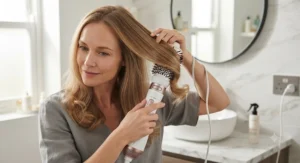
6. ghd Duet Blowdry — best for daily use with genuinely minimal heat damage
If there’s one entry on this list built almost entirely around the phrase gentle hot air brush for thin hair, it’s this one. The Duet Blowdry runs at a fixed, sensor-monitored 120°C — measured 400 times a second by the brand’s own temperature-sensing tech — compared with the 185°C-plus that traditional straighteners and many rival hot brushes reach. Beauty journalists who’ve tested it against curly, thick and fine hair types specifically single out its performance on thinning and fragile hair, describing daily use as realistic precisely because the temperature ceiling is so conservative. The Heat-Air Xchange system heats both the elliptical barrel plate and the bristles themselves, rather than relying purely on blown air, which is what lets it dry and style simultaneously in around ten to twelve minutes rather than the twenty-plus a standard dryer-and-brush combo demands. What most buyers overlook about this model is the brushless motor, which isn’t just a battery-life gimmick on cordless tools — here it means quieter, more consistent airflow with less vibration transferred into the barrel, which reduces mechanical tugging on fine strands mid-style. The genuine catch is price: at roughly £380, this is a serious investment, and it only comes in one heat setting, so there’s no dialling down further for extremely reactive scalps.
Pros:
- ✅ Fixed low 120°C ceiling, verified by real-time sensors
- ✅ Dries and styles simultaneously, cutting total heat time
- ✅ Consistently praised for daily use on thinning, fragile hair
Cons:
- ❌ Premium price point, around £380
- ❌ Single fixed heat setting offers no further downward adjustment
For fine hair heat damage prevention as the single top priority, this is arguably the most convincing option on the entire list — you’re paying for restraint, not raw power.
7. Dyson Airwrap i.d. Multi-Styler — best multi-tool investment for versatility
The Airwrap works on a genuinely different principle to every other brush here: the Coanda effect draws surrounding air across the barrel to curl and smooth hair using airflow rather than direct high heat contact, which is precisely why it’s become a go-to recommendation for fine hair that can’t tolerate sustained high temperatures. Interchangeable barrels mean you’re not locked into one styling outcome — round-brush volumising attachments sit alongside curling barrels and a smoothing dryer nozzle, so one tool replaces what would otherwise be three or four separate purchases. Based on the spec comparison with the rest of this list, its intelligent heat control continuously measures air temperature and adjusts to help avoid extreme heat exposure, a claim that beauty testers have broadly corroborated in comparative reviews against straighteners and conventional hot brushes. What the spec sheet won’t tell you, but reviewer consensus suggests, is that the learning curve is real — the styling technique differs enough from a standard hot brush that first-time users often need a few sessions before results feel consistent, which is worth knowing before you commit to the top end of the price range. For fine hair specifically, the appeal is less about one killer feature and more about the sheer flexibility: you can go from volumising roots to smoothing lengths without switching tools or letting hair cool and reheat between steps.
Pros:
- ✅ Airflow-based styling avoids sustained direct high heat
- ✅ Interchangeable barrels replace several separate tools
- ✅ Continuous temperature monitoring during use
Cons:
- ❌ Highest price on this list, £400-£480 range
- ❌ Noticeable learning curve compared with a standard hot brush
If budget genuinely isn’t the deciding factor and you want one tool for every fine-hair styling need, this is the investment pick — just budget in a bit of practice time.
Getting the Best Results: A Practical Usage Guide for Fine Hair
Owning the right hot air brush for fine hair only gets you halfway there — technique matters just as much as the tool itself. Start with a lightweight, sulphate-free shampoo and a conditioner applied mid-length to ends only, since fine hair weighs down fast when product sits at the root. Always towel- or air-dry to roughly 60-70% before reaching for any hot brush; working from soaking wet dramatically increases total heat exposure time, since the tool has to do double duty evaporating water and shaping simultaneously. Section your hair into smaller-than-you’d-think pieces — fine hair tangles less than thick hair, so you can afford thinner sections that pass through the barrel faster and more evenly, rather than overloading the bristles.
In the first thirty days with a new brush, the most common mistake is defaulting to the highest heat setting because it feels like it’ll finish faster. It won’t meaningfully speed things up on fine hair, and it will accelerate the very heat damage you’re trying to avoid. A weekly maintenance habit worth building: wipe the barrel and bristles with a slightly damp cloth once product residue builds up, since clogged bristles transfer heat unevenly and can snag strands. Finish every session with a cool-shot pass if your tool has one — it’s what actually locks the cuticle down and gives volume genuine staying power rather than heat-styled hair that collapses within the hour.
Real-World Scenarios: Matching the Brush to Your Fine Hair
Picture three different readers landing on this page. First, the twenty-something student with fine, shoulder-length hair and a tight morning budget — she wants something fast, forgiving of rushed mornings, and cheap enough to replace without heartbreak. The Remington Blow Dry & Style Caring Airstyler or BaByliss Big Hair Petite Rotating Styler both fit here: low investment, genuinely gentle heat, and light enough to use one-handed while scrolling her phone with the other.
Second, picture someone in their forties whose fine hair has thinned noticeably post-pregnancy or through hormonal changes, and who’s understandably nervous about anything that adds extra stress to already-vulnerable strands. This is the ghd Duet Blowdry or Cloud Nine Original Hot Brush territory — tools built around precise, conservative heat ceilings rather than raw drying speed, worth the higher spend because the priority is protection over convenience.
Third, someone with fine but long hair who colours regularly and wants one tool that can volumise roots one day and smooth frizz the next without buying separate straighteners and curling wands. The Dyson Airwrap i.d. Multi-Styler earns its price tag here specifically because of that versatility — daily use over months typically works out cheaper per styling session than replacing several single-purpose tools.
Problem → Solution: Fixing the Most Common Fine-Hair Frustrations
Fine hair comes with a recognisable set of complaints, and most have a specific fix rather than needing a total routine overhaul. If your biggest issue is volume collapsing within hours, the fix usually isn’t more heat — it’s a cool-shot finish plus a barrel size matched to your length, since an oversized barrel like the 38mm on the Beauty Works XXL Volume Hot Brush can actually flatten shorter fine hair rather than lift it. If static and flyaways are the recurring headache, prioritise a brush with genuine ionic technology, since fine strands carry less natural weight to counteract static build-up on their own.
For hair that feels increasingly dry or straw-like after repeated hot brush use, the likely culprit is heat exposure time rather than the tool itself — switch to rough-drying further before styling, and consider a fixed low-temperature option like the ghd Duet Blowdry rather than defaulting to a high setting out of habit. And if you’re finding the brush physically tugs or snags mid-style, check bristle spacing and barrel weight before blaming your hair; a lighter, better-designed barrel like the BaByliss Big Hair Petite Rotating Styler solves this mechanically rather than through heat adjustment at all.
How to Choose a Hot Air Brush That Doesn’t Damage Fine Hair
Picking the right hot air brush for fine hair comes down to a handful of genuinely decisive factors, in rough order of priority:
- Check the lowest available heat setting first. A tool’s maximum temperature matters less than whether its lowest setting is genuinely low — anything with a floor around 100-130°C is doing real fine-hair heat damage prevention work.
- Weigh the barrel, not just the brush. A heavier barrel means more strain on the hair shaft during rotation and wrapping, so a lightweight brush barrel should be a real priority, not an afterthought.
- Look for ionic or ceramic technology. These reduce static and distribute heat more evenly, both of which matter disproportionately for fine strands.
- Match barrel size to your length. Shorter fine hair generally suits a smaller 25-32mm barrel; longer fine hair benefits from 38mm-plus for fewer overall passes.
- Prioritise a cool-shot or auto shut-off function. These aren’t gimmicks — they’re what actually locks a style in place and protect against accidental overheating.
- Consider wet-to-dry capability versus dry-only. Wet-to-dry tools cut total styling time but generally cost more; dry-only tools are cheaper but require a pre-drying step.
Based on the spec comparison across all seven brushes above, the tools that consistently score best for fine hair combine a low fixed or adjustable heat floor with a genuinely light barrel — heat and weight together, not heat alone, determine how gentle a brush actually feels in daily use.
Gentle Hot Air Brush vs Regular Hairdryer and Round Brush
The traditional combination of a separate hairdryer and round brush still has its defenders, and it’s worth being honest about where it beats a dedicated hot air brush. A standalone hairdryer typically offers more raw airflow and can be held further from the scalp, giving you more control over exact heat proximity — useful if your fine hair is genuinely reactive to heat. It’s also usually cheaper to replace either half if one component fails.
Where a gentle hot air brush for thin hair pulls ahead is efficiency and consistency: drying and shaping in one motion means less total time under any heat at all, since you’re not drying fully and then reheating the same strands with a curling brush afterwards. It also removes the coordination challenge of holding a dryer in one hand angled correctly while manoeuvring a round brush with the other — a fiddly process that often means accidentally lingering too long on stubborn sections. For most fine-hair users, the one-step approach wins on total heat exposure even when its peak temperature is similar to a standalone dryer, simply because the session is shorter and more controlled.
Best Blowout Brush for Fine Hair: What Reviewers Actually Say
Trawling through aggregated review sentiment across the seven tools above, alongside independent comparative testing such as Which?’s hot brush reviews, a consistent pattern emerges: the best blowout brush for fine hair, according to real user feedback, is rarely the one with the highest wattage or the flashiest marketing claims. Reviewers of the Revlon One-Step Volumizer Plus 2.0 repeatedly highlight speed and detangling over raw curl longevity, while feedback on the ghd Duet Blowdry and Cloud Nine Original Hot Brush leans heavily on words like “gentle” and “no heat damage” rather than “powerful.” That’s a meaningful signal — fine-hair users searching for a blowout brush are, overwhelmingly, prioritising how their hair feels the next day over how dramatic the curl looks in the first hour. A recurring theme across independent reviews is that barrel comfort and weight distribution show up in feedback almost as often as heat performance, reinforcing that the “best” pick genuinely depends on matching hair length and fragility to the tool rather than chasing a single universal winner.
Low Heat Hot Air Brush: Why Temperature Control Matters Most
Of every spec on a hot air brush, temperature ceiling is the one fine-hair buyers should weight most heavily, and it’s worth understanding why. Fine hair has a smaller diameter shaft with proportionally less internal structure to absorb and dissipate heat safely compared with coarse or thick hair, meaning the same temperature that’s perfectly safe on one hair type can be genuinely damaging on another. A dedicated low heat hot air brush — whether that’s the ghd Duet Blowdry’s fixed 120°C or an adjustable tool dialled down manually — works on the same ionic and ceramic heating principles that underpin standard hairdryer technology, just tuned lower, and it reduces the risk of protein degradation in the hair shaft, which is what ultimately shows up as brittleness, split ends and that dry, straw-like texture so many fine-hair users report after repeated high-heat styling. NHS hair care guidance is blunt on this point, noting that heat weakens hair and has a drying effect that leaves it more prone to breakage, which is exactly the mechanism a genuinely low heat setting is designed to slow down. Practically speaking, that means treating “low heat” not as a compromise but as the correct default setting for fine hair, reserving higher temperatures for occasional special-occasion styling rather than daily use.
Fine Hair Heat Damage Prevention: The Science Bit
Heat damage on fine hair happens at the cuticle level first — the outer protective layer of overlapping scales lifts and roughens under sustained high temperatures, which is what causes that dull, frizzy look long before any visible breakage appears. Because fine hair has a smaller shaft diameter, there’s simply less cuticle mass protecting the inner cortex, so damage that might take months to show on thick hair can become visible within weeks on fine strands exposed to the same heat routine. This is precisely why fine hair heat damage prevention isn’t really about avoiding heat tools altogether — it’s about controlling three variables together: peak temperature, total exposure time, and mechanical friction from bristles or plates dragging across the hair repeatedly.
A heat protectant spray genuinely does meaningful work here by forming a thin barrier that raises the temperature threshold at which damage begins, and it’s worth treating as non-negotiable regardless of which tool from this list you choose. Combining a protectant with a lower heat setting and a pre-drying step before hot brush use stacks all three protective factors at once, rather than relying on any single fix to do the whole job.
Lightweight Brush Barrel: Why Barrel Weight and Size Matter for Fine Hair
It’s easy to fixate entirely on temperature specs and overlook barrel weight, but for fine hair the two matter almost equally. A heavier barrel demands more tension to hold in place mid-rotation, and that tension transfers directly into the hair shaft at the point of contact — repeated over months, that mechanical stress contributes to breakage independently of any heat damage at all. A genuinely lightweight brush barrel, like the one on the BaByliss Big Hair Petite Rotating Styler, reduces that pulling force considerably, which is part of why lighter tools consistently show up in aggregated reviews as more comfortable for longer daily sessions.
Barrel diameter matters too, though in a less obvious way: an oversized barrel on fine hair that’s also short can actually work against volume rather than for it, because there isn’t enough hair length to properly wrap and tension around the barrel before the heat cycle finishes. Matching barrel size to your actual hair length, not just your styling goal, is one of the most overlooked decisions in this entire buying process.
Gentle Volumising for Fine Hair: Getting Body Without Overdoing It
The instinct with fine hair is often to chase maximum volume through maximum heat, but gentle volumising fine hair techniques actually rely more on technique and product than raw temperature. Root-lifting mousse applied to damp hair before any heat styling gives the hair shaft something to grip onto structurally, meaning the hot air brush has to do proportionally less work to achieve the same lift. Styling with the brush angled slightly away from the scalp, rather than flat against it, creates a more natural root bend without requiring prolonged heat contact at the follicle itself, where fine hair is most vulnerable.
The most effective gentle volumising for fine hair typically comes from working in the opposite direction to hair growth briefly at the root before smoothing back into place — a technique reviewers of the Beauty Works XXL Volume Hot Brush specifically credit for longer-lasting lift compared with simply blow-drying straight down. Volume achieved this way tends to hold better through the day than volume forced purely through high heat, precisely because it’s built into the hair’s structure rather than temporarily reshaped by temperature alone.
Common Mistakes When Buying a Hot Air Brush for Fine Hair
The single biggest mistake buyers make is choosing based on wattage alone, assuming higher power automatically means better results — for fine hair, it frequently means the opposite, with excess airflow and heat stripping moisture faster than the hair can tolerate. A close second is ignoring barrel weight entirely and focusing purely on heat specs, which overlooks the mechanical stress a heavy barrel places on fragile strands regardless of temperature setting.
Buyers also commonly underestimate how much attachment variety matters; a single fixed-barrel tool can leave you stuck if your hair length or desired style changes, whereas multi-attachment options like the Remington Blow Dry & Style Caring Airstyler offer more long-term flexibility for the same rough spend. Finally, many shoppers skip checking whether a tool works wet-to-dry or dry-only before buying, then discover post-purchase that their existing routine doesn’t match the tool’s requirements — a frustrating and entirely avoidable mismatch that a few minutes of spec-checking solves. It’s also worth a quick read of Electrical Safety First’s guidance on heated hair tools before your first use, particularly around plug checks and safe storage while the barrel is still hot.
Long-Term Cost & Maintenance
A cheaper hot air brush isn’t automatically the better-value option once you factor in lifespan and replacement frequency. Budget tools in the £35-£50 range are genuinely good value if used a few times weekly, but aggregated review sentiment suggests motors in this price bracket tend to show performance decline within one to two years of regular use, particularly if they’re run at higher heat settings than recommended. Mid-range tools like the Beauty Works XXL Volume Hot Brush generally carry more robust motor components and digital heat regulation that reduces strain from temperature overshoot, which can meaningfully extend working life.
At the premium end, the ghd Duet Blowdry and Dyson Airwrap i.d. Multi-Styler both come backed by longer manufacturer warranties, and the multi-attachment design of the Airwrap in particular means you’re effectively paying for several tools’ worth of function in one purchase, which changes the cost-per-use maths considerably over a two-to-three-year ownership period. Cleaning matters for longevity across every price point — a clogged air filter forces any motor to work harder to maintain airflow, which both shortens tool lifespan and pushes actual heat delivered to the hair higher than the dial suggests, undermining exactly the gentleness you bought the tool for in the first place.
🔥 Don’t Miss These Exclusive Deals!
🔍 Give your fine hair the gentle upgrade it deserves. Click on any highlighted pick above to check current pricing and availability, and start building a styling routine that actually protects your strands instead of frying them.
FAQ
❓ What's the best hot air brush for fine hair on a budget?
❓ Is a hot air brush actually less damaging than a regular hairdryer?
❓ What temperature is safest for fine hair?
❓ Can a hot air brush add volume to very flat, fine hair?
❓ How often should I use a hot air brush on fine hair without causing damage?
Conclusion
There’s no single universal winner among hot air brushes for fine hair, because the “best” pick genuinely depends on your length, your budget and how compromised your hair already is. If you want reliable, low-risk daily performance without a big spend, the Remington Blow Dry & Style Caring Airstyler or BaByliss Big Hair Petite Rotating Styler will serve you well. If your hair is already fragile from colour or previous heat damage, the extra control offered by the Cloud Nine Original Hot Brush or the near-clinical restraint of the ghd Duet Blowdry genuinely justifies the higher price. And if you want one tool to handle everything from volumising to smoothing without swapping devices, the Dyson Airwrap i.d. Multi-Styler remains the most versatile investment on this list.
Whichever you choose, the core principle stays the same: prioritise a genuinely low heat floor, a lightweight barrel, and sensible daily technique over raw power every time. Fine hair rewards restraint far more than it rewards intensity, and now you’ve got the research to prove it.
Recommended for You
- Best Hot Air Brush 2026: 7 Genuinely Brilliant Picks Tested
- Best Multi-Styler Hair Tool 2026: 7 Top Picks You’ll Love
- Heatless Curling Methods 2026: 7 Tools That Actually Work
Disclaimer: This article contains affiliate links. As an Amazon Associate, I earn from qualifying purchases. If you purchase products through these links, we may earn a small commission at no additional cost to you.
✨ Found this helpful? Share it with your friends! 💬🤗
