
In This Article
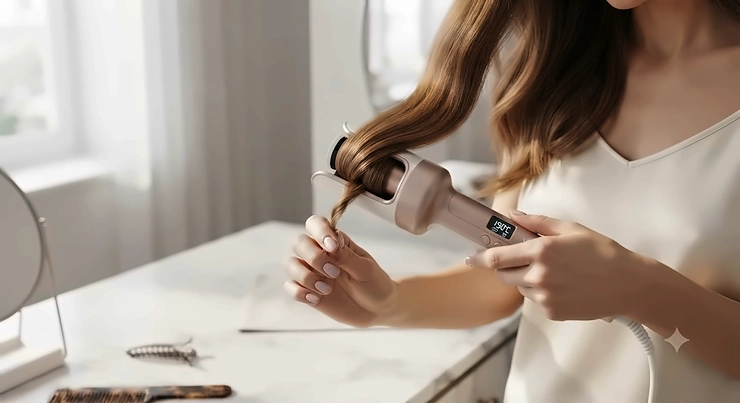
There’s a particular kind of morning chaos that only a curling wand can cause. Wrist aching, fringe half-scorched, one flawless ringlet sitting smugly next to eleven flat disasters — most of us have lived it. That’s exactly the mess an automatic hair curler was built to end. Rather than you doing the twisting, wrapping and praying, the machine pulls a section of hair into a heated chamber, rotates it for you, and releases a curl that looks suspiciously like it came from a salon chair.
This guide cuts through the marketing fluff. We’ve researched seven real, currently available machines — from a £35 Remington rotating wand to Dyson’s £480 airflow styler — and pulled apart their actual specs, their genuine aggregated review sentiment, and where each one falls flat. Whether you’re after the best auto curler for long hair, a compact rotating curler for beginners, or a fully cordless automatic curler for the gym bag, there’s a real, verified pick below. According to Wikipedia’s overview of hair irons, curling tools work by using heat (or heated airflow) to temporarily reshape the hair shaft — automatic models simply automate the wrapping mechanics that a manual iron leaves entirely to you.
We’ll also flag the honest limitations: no automatic curler works miracles on very short hair, none replace a proper heat-protectant routine, and “self-curling” doesn’t mean zero technique. Read on for the full breakdown.
Quick Comparison Table
| Product | Type | Price Range | Best For |
|---|---|---|---|
| Dyson Airwrap i.d | Airflow auto-wrap | £370-£480 | Premium buyers wanting low heat damage |
| BaByliss Style Secret Air | Airflow rotating | £90-£120 | Beginners wanting versatile styles |
| TYMO CurlPro Plus | Heated rotating barrel | £70-£100 | Best auto curler for long hair |
| CHI Spin N Curl | Heated rotating chamber | £80-£110 | Shoulder-length hair, salon-grade heat |
| Bluvol R10 Apex | Cordless rotating barrel | £90-£130 | Cordless automatic curler, travel |
| Remington Curl Revolution CI606 | Heated rotating barrel | £30-£50 | Tight budgets, first-time buyers |
| BaByliss Curl Secret 2667U | Heated auto-curl chamber | £60-£90 | Dual-voltage travel, simple 2-setting use |
Looking at the table, the split is really about how much control you want to pay for. The Dyson Airwrap i.d and BaByliss Style Secret Air use moving air rather than pure heat to form the curl, which is gentler on hair over time but costs considerably more. The TYMO CurlPro Plus, CHI Spin N Curl and Remington Curl Revolution CI606 are conventional heated rotating barrels — simpler mechanically, cheaper to buy, and arguably easier to fix if something goes wrong. If you travel a lot, the Bluvol R10 Apex and BaByliss Curl Secret 2667U are the two worth shortlisting, since one goes cordless and the other goes dual-voltage.
💬 Just one click — help others make better buying decisions too!😊
Top 7 Automatic Hair Curlers: Expert Analysis
1. Dyson Airwrap i.d — smart auto-adjusting airflow curls
The Dyson Airwrap i.d is the machine everyone name-checks, and for once the hype is grounded in something real: Dyson’s Coanda airflow effect physically wraps hair around the barrel using fast-moving air, so the styling temperature can stay far lower than a conventional iron. RFID chips in each attachment let the machine auto-adjust heat and airflow the instant you clip one on, which removes a genuine source of user error. Three heat and three speed settings give you room to tune the finish, and the accompanying app can store personalised combinations for different hair days.
Based on the spec comparison, this is the only machine on our list that dries and curls in one pass, which matters if you’re currently drying with one tool and curling with another. Reviewers consistently report that curls last through a full day and that the reduced heat noticeably improves how hair feels over months of repeated use, though several also note a real learning curve in the first few sessions.
Pros:
- ✅ RFID auto-adjusts heat per attachment automatically
- ✅ Airflow curling causes markedly less heat damage
- ✅ Doubles as a dryer, smoother and volumiser in one
Cons:
- ❌ Priced well above every other option here
- ❌ Learning curve is steeper for total beginners
At around £370-£480 depending on the attachment set, the Dyson Airwrap i.d is a genuine long-term investment rather than an impulse buy — it earns its price if you’ll use every attachment, not just the curl barrels.
2. BaByliss Style Secret Air — airflow rotation for effortless beginners
The BaByliss Style Secret Air takes Dyson’s airflow concept and prices it for the rest of us. Hair is drawn into a rotating chamber by moving air rather than a purely heated clamp, with four heat and airflow settings, four timer lengths and three rotation directions letting you dial in anything from tight ringlets to a soft blow-dry finish. It heats to working temperature in about 90 seconds, which is respectable for an airflow-based tool.
What most buyers overlook about this model is that the rotation direction control genuinely changes the finish — alternating directions gives a lived-in, undone look, while one-way rotation gives a more polished, uniform curl. Reviewers consistently note it performs particularly well on collar-length hair, a length that many rotating chambers struggle with, and Argos customer feedback repeatedly praises how approachable it is for people who’ve never managed a curling iron before.
Pros:
- ✅ Four heat, timer and rotation combinations for control
- ✅ Works well even on shorter, collar-length hair
- ✅ Three-year manufacturer guarantee for peace of mind
Cons:
- ❌ Noticeably pricier than BaByliss’s basic Curl Secret
- ❌ Full-head styling takes longer than single-clamp wands
Sitting in the £90-£120 range, the BaByliss Style Secret Air is the strongest all-rounder here if you want Dyson-style airflow curling without the Dyson-style bill.
3. TYMO CurlPro Plus — extended barrel built for long, thick hair
If your main question is which is the best auto curler for long hair, the TYMO CurlPro Plus answers it with a simple engineering choice: a 110mm barrel, nearly double the length of most rotating chambers, so it grabs bigger sections and finishes a full head faster. A one-tap automatic rotation system pulls the hair in, and a built-in timer beeps when the curl is set — no counting seconds under your breath.
The 600-million ionic output paired with T-GLOSS tourmaline ceramic coating is there to fight frizz and static, and three heat settings (160-210°C) cover most hair types without needing a dial you have to guess at. Reviewers consistently report the curls hold for a full day and sometimes into a second, and independent hair-strength testing cited by the manufacturer found no measurable damage to hair strength or shine after repeated use — though as with any manufacturer-commissioned study, it’s worth treating as supporting evidence rather than independent proof. The tool’s smart anti-tangle sensor is a genuinely useful safety net: if a section gets too thick, the barrel stops rotating instead of chewing through your hair.
Pros:
- ✅ Extra-long 110mm barrel suits long or thick hair
- ✅ Anti-tangle sensor halts rotation before hair snags
- ✅ Built-in timer removes the guesswork for beginners
Cons:
- ❌ Corded only, no cordless version at this barrel size
- ❌ Best results need consistent, evenly-sized sections
Priced around £70-£100, the TYMO CurlPro Plus is the pick to shortlist if length and thickness are your main styling challenge.
4. CHI Spin N Curl — professional-grade rotating chamber
CHI built its name on ceramic flat irons used in salons for decades, and the CHI Spin N Curl brings that same far-infrared ceramic heat technology to an automatic format. A digital display shows exact temperature, with presets tuned specifically for fine (370°F), medium (390°F) and coarse (410°F) hair, so you’re not left guessing which number suits your texture. Hair is drawn into the chamber, held, then released with a beep — the whole cycle typically running under 20 seconds per section.
Here’s what to weigh: the chamber is genuinely designed for shoulder-length hair between roughly 6 and 16 inches, so it’s not the tool for waist-length hair — that job goes to the longer-barrelled TYMO instead. Reviewers consistently note that the automatic shut-off and tangle protection make it feel safer than a standard tong, and several long-term owners report the build quality holding up over years of regular use, reinforcing CHI’s reputation for durability in this category. It draws on decades of ceramic-heat expertise that CHI has built primarily through professional styling tools.
Pros:
- ✅ Preset temperatures matched to fine, medium, coarse hair
- ✅ Trusted professional heritage brand and build quality
- ✅ Automatic shut-off and tangle protection included
Cons:
- ❌ Chamber size limits it to shoulder-length hair
- ❌ Corded design with a fairly firm 9ft cable
At roughly £80-£110, the CHI Spin N Curl suits anyone who wants salon-grade heat precision and doesn’t mind staying corded.
5. Bluvol R10 Apex — cordless automatic curler for life on the move
For anyone specifically hunting a cordless automatic curler, the Bluvol R10 Apex is one of the few genuinely rechargeable rotating barrels on the market rather than a corded tool with a travel pouch bundled in. Dual 3,500mAh batteries deliver over 50 minutes of continuous styling, which is enough for a full head with room to spare, and a one-touch flight-mode shutdown makes it airline-security-friendly.
What most buyers overlook here is the memory mode: it saves your last-used heat and timer combination, so repeat users skip the setup step every single morning. Three heat settings (160°C, 185°C, 210°C) and three timer presets (8, 10, 12 seconds) are more limited than corded rivals, but a smart tangle sensor auto-reverses if hair wraps incorrectly, and a 360° insulated barrel stays cool enough to touch — a genuinely useful safety feature in a device with no cord to warn you it’s live. Voice prompts walk first-timers through each step, addressing the “how do I even start” hesitation that puts a lot of beginners off automatic curlers altogether.
Pros:
- ✅ 50+ minutes of cordless use from dual batteries
- ✅ Memory mode remembers your preferred settings
- ✅ Voice-guided steps genuinely help total beginners
Cons:
- ❌ Twin batteries add noticeable handle weight
- ❌ Only three timer presets limit fine curl-tightness control
Expect to pay roughly £90-£130, positioning the Bluvol R10 Apex as a premium-adjacent price for a genuinely cord-free experience.
6. Remington Curl Revolution CI606 — budget-friendly automatic rotating barrel
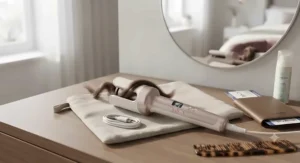
Not everyone needs — or wants — to spend £300 on airflow technology, and the Remington Curl Revolution CI606 is the honest answer for that reader. Remington’s Instant Curl technology automatically feeds a section of hair into the rotating barrel, with five digital temperature settings up to 230°C and a rapid 15-second heat-up. A temperature-lock function stops the setting shifting mid-style, which is a small but genuinely thoughtful touch at this price point.
The barrel can rotate in either a single direction for a uniform, polished look, or in alternating directions for something closer to undone beach waves — a level of flexibility that’s unusual for a curler in this price bracket. Reviewers consistently note the argan-oil-infused ceramic coating leaves hair feeling smoother than expected, and that it’s a sensible first automatic curler for someone who’s never used one before, though the single barrel size means you’re locked into one curl style rather than several.
Pros:
- ✅ Rotates both directions for uniform or natural curls
- ✅ Rapid 15-second heat-up saves time each morning
- ✅ Temperature lock prevents accidental setting changes
Cons:
- ❌ Single barrel size limits curl-style variety
- ❌ Fewer heat settings than premium rotating rivals
Typically found in the £30-£50 range, the Remington Curl Revolution CI606 remains the clearest budget entry point into automatic curling.
7. BaByliss Curl Secret 2667U — dual-voltage classic auto-curl chamber
The original BaByliss Curl Secret popularised the whole “auto curl chamber” concept, and the 2667U update keeps that formula largely intact: hair is drawn gently into a ceramic chamber, held, and heated from all directions at either 210°C or 230°C. Alternating curl direction is built in as standard, giving a more natural finish than a static clamp-and-hold tong ever could.
Reviewers consistently note two things in opposite directions — the curls it produces are genuinely long-lasting and shiny, but a handful of users report hair occasionally catching in the curling mechanism, so sectioning carefully and avoiding product beforehand matters more here than on some rivals. Because the chamber works best on hair that starts out straight or loosely wavy, it’s honestly not the tool for someone trying to reshape existing curls into something different. Its dual-voltage compatibility, however, makes it a sensible pick for anyone travelling regularly between the UK and abroad.
Pros:
- ✅ Dual voltage makes it genuinely travel-friendly
- ✅ Simple two-setting operation suits total beginners
- ✅ Ionic and ceramic combination reduces frizz well
Cons:
- ❌ Some users report hair catching in the chamber
- ❌ Best suited to naturally straight or wavy starting hair
At around £60-£90, the BaByliss Curl Secret 2667U remains a solid mid-range choice, particularly for frequent travellers.
Rotating Curler for Beginners: A Practical Usage Guide
If you’ve never used an automatic hair curler before, the single biggest mistake is treating it like a manual wand and rushing sections in too fast. Start with hair that’s fully dry, brushed smooth and free of any leave-in product with a wax or oil base — most manufacturers, including BaByliss and TYMO, specifically warn that residue can gum up the rotating mechanism over time. Section hair into pieces roughly one to one-and-a-half inches wide; thicker sections are the number one cause of the “hair caught in the chamber” complaint that shows up in reviews across nearly every brand.
For your first few sessions, pick a mid-range heat setting rather than the highest one — you can always go hotter once you know how your hair responds, but you can’t undo heat damage from starting too aggressively. Hold the section taut but not stretched tight as it feeds in, and resist the urge to tug if the machine pauses; most models, including the TYMO CurlPro Plus and Bluvol R10 Apex, are designed to stop and release automatically rather than force a tangle through.
In the first 30 days, the most common mistake beginners make is inconsistency — curling some sections close to the root and others starting mid-shaft, which creates an uneven finish that looks accidental rather than styled. Keep your starting point consistent across the whole head, and finish with a light hold spray rather than a heavy one, since heavy products can weigh freshly formed curls flat within an hour. Clean the barrel or chamber every few weeks with the manufacturer’s supplied brush or a dry cloth — product buildup inside the chamber is the leading cause of reduced grip and rotation speed over time.
Real-World Scenarios: Matching the Curler to the Person
Picture three very different mornings. First, a university student with fine, shoulder-length hair and eight minutes before a lecture — for her, the Remington Curl Revolution CI606 or CHI Spin N Curl make the most sense: fast heat-up, forgiving chamber size, and a price that doesn’t sting if student life means it gets knocked off a shelf.
Second, someone with long, thick hair who curls two or three times a week and values consistency over speed — the TYMO CurlPro Plus‘s extended barrel handles bigger sections in fewer passes, cutting total styling time noticeably compared with a standard-length chamber, and its anti-tangle sensor reduces the risk that comes with denser hair.
Third, a frequent flyer who needs a cordless automatic curler that survives hand luggage restrictions and hotel bathrooms with exactly one awkward socket — here the Bluvol R10 Apex solves the power problem outright, while the BaByliss Curl Secret 2667U is the dual-voltage backup if a cordless model feels like overkill for the budget. None of these choices are about one machine being universally “best” — they’re about matching barrel size, power source and price to how and when you’ll actually use it, which is the single most useful filter buyers consistently skip.
How to Choose an Automatic Hair Curler
- Match barrel or chamber length to your hair length. Shoulder-length hair suits compact chambers like the CHI Spin N Curl; longer or thicker hair needs an extended barrel like the TYMO CurlPro Plus to avoid multiple passes per section.
- Decide if cordless is worth the premium. A cordless automatic curler like the Bluvol R10 Apex adds real convenience for travel, but expect a heavier handle and fewer heat/timer combinations than corded rivals.
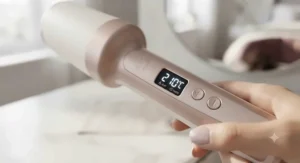
- Check the heat range against your hair type. Fine hair rarely needs settings above 190°C; coarse or very thick hair may need the 210-230°C range offered by models like BaByliss Curl Secret 2667U or Remington Curl Revolution CI606.
- Weigh airflow versus pure heat technology. Airflow-based tools such as the Dyson Airwrap i.d and BaByliss Style Secret Air generally cause less cumulative heat damage, at a noticeably higher purchase price.
- Look for genuine safety features, not marketing terms. Automatic shut-off, tangle sensors that reverse rather than force, and cool-touch barrel exteriors are worth more in daily use than an extra colour option.
- Factor in dual voltage if you travel. Not every automatic curler ships dual-voltage as standard — the BaByliss Curl Secret 2667U does, which matters more than most buyers realise until they’re stuck abroad with a dead adapter.
- Read aggregated review sentiment, not star averages alone. A 4.5-star average can hide a recurring specific complaint (tangling, short battery life); scan for repeated phrases across dozens of reviews rather than trusting the headline number.
Common Mistakes When Buying an Automatic Hair Curler
The most frequent error is buying based on barrel diameter alone without checking chamber or barrel length — a 1-inch barrel that’s too short simply won’t grab enough hair per section if you have long or thick hair, regardless of how good the rotation technology is. A close second is ignoring cord length and voltage entirely, then discovering the swivel cord barely reaches a bathroom mirror or that the plug isn’t dual-voltage before a trip abroad.
Buyers also frequently underestimate how much technique still matters. “Automatic” refers to the rotation and, in some cases, the timing — not the sectioning, the starting point, or how taut you hold each strand, all of which still shape the final result. Skipping the first few practice sessions on a low-stakes day (rather than five minutes before an event) is a mistake that shows up repeatedly in negative reviews, most of which turn out to be about user technique rather than the machine itself. Finally, many shoppers overlook maintenance entirely: chambers and barrels that aren’t cleaned regularly lose grip and rotation smoothness within months, regardless of how premium the original purchase was.
Automatic Hair Curler vs Traditional Curling Wand
A traditional manual wand gives you total creative control — you choose exactly where each curl starts, how tight the wrap is, and how long the heat holds — but it demands practice, coordination, and inevitably a few singed fingers along the way. An automatic hair curler trades some of that control for consistency and speed: the rotating barrel or chamber does the wrapping itself, timing the heat exposure so results are far more uniform section to section, which is precisely why rotating curlers for beginners tend to outperform manual wands in early attempts.
Where automatic models fall down is versatility — a skilled user with a manual wand can create tight ringlets, loose waves and root volume all in one session by varying technique, while most automatic chambers produce a fairly consistent curl type regardless of how you use them. Airflow models like the Dyson Airwrap i.d narrow that gap by offering multiple attachments and settings, but even then, a manual wand remains the more flexible tool in genuinely experienced hands. For most people curling their own hair at home, though, the consistency and reduced learning curve of an automatic curler outweighs the lost flexibility — which is exactly why the category has grown so quickly.
How Self-Curling Iron Technology Actually Works
Underneath the marketing language, self-curling iron technology comes down to one of two mechanical approaches. The first, used by the TYMO CurlPro Plus, CHI Spin N Curl, Remington Curl Revolution CI606 and BaByliss Curl Secret 2667U, is a heated auto-rotating barrel or chamber: a small motor spins the barrel (or an internal mechanism draws hair into a chamber) while ceramic or tourmaline-coated plates apply heat directly. Sensors detect when a strand has fully wrapped or a set time has passed, then either beep, release, or both.
The second approach, used by the Dyson Airwrap i.d and BaByliss Style Secret Air, replaces most of the direct heat contact with high-speed airflow, using the Coanda effect to physically wrap hair around a barrel using moving air rather than a spinning motor gripping the strand. This is why airflow-based tools tend to run at lower surface temperatures while still producing a defined curl — the styling force comes from air pressure rather than heat alone. Both approaches rely on anti-tangle sensing to prevent the hair from wrapping too tightly or too thick a section catching in the mechanism, which is the underlying safety feature behind nearly every “auto shut-off” or “tangle protection” claim on the market. Understanding this distinction matters more than most spec sheets suggest, since it directly predicts how gentle — or how fast — a given curler will be in daily use.
Best Auto Curler for Long Hair: What Actually Matters
Length changes the maths on automatic curling more than any other single factor. A standard chamber built for shoulder-length hair, like the CHI Spin N Curl, simply runs out of room on hair reaching mid-back or longer, forcing you to curl in overlapping passes that can leave visible seams. This is precisely the gap the TYMO CurlPro Plus was designed to close, with its 110mm barrel — nearly double the standard length — grabbing a larger section per pass and cutting overall styling time.
Beyond barrel length, long hair also needs a device that won’t overheat before it finishes a full head; models with a genuine auto-shutoff timer rather than a simple on/off switch are worth prioritising, since a full head of long hair realistically takes 15-25 minutes to curl in evenly sized sections. Ionic and ceramic coatings matter more here too, since longer hair has more length exposed to repeated heat styling over its lifetime, making frizz-reduction technology a genuinely practical feature rather than a marketing add-on. If cordless convenience matters as much as length, the Bluvol R10 Apex‘s 30% longer barrel and 50-minute battery life make it a reasonable middle ground, though its narrower barrel diameter means slightly smaller sections per pass than the TYMO.
Long-Term Cost & Maintenance
The purchase price is only part of the real cost of owning an automatic hair curler. Budget models like the Remington Curl Revolution CI606 cost far less upfront but typically carry shorter warranty periods and fewer replaceable parts, so a mechanical fault later in life usually means replacing the whole unit. Premium options like the Dyson Airwrap i.d come with a longer manufacturer warranty and genuinely serviceable attachments, which can offset the higher initial outlay if you keep the machine for several years rather than replacing it annually.
Cordless models introduce a maintenance factor that corded tools don’t have: battery degradation. The Bluvol R10 Apex‘s dual 3,500mAh batteries will hold less charge after roughly 300-500 charge cycles, which is worth factoring in if you plan to keep it long-term, since batteries in most consumer devices aren’t user-replaceable. Cost-per-use also favours whichever tool you’ll actually reach for on a normal Tuesday rather than the one that looked most impressive in the box — a £40 curler used three times a week for two years works out cheaper per session than a £450 one left in a drawer after the novelty fades. Regular chamber cleaning, avoiding heavy styling product before use, and storing the tool in its heat-proof pouch all extend working life regardless of price point, and are honestly the most overlooked “maintenance” factor across every brand reviewed here.
Safety, Regulations and Compliance
All electrical hair styling appliances sold in the UK must meet the Plugs and Sockets etc. (Safety) Regulations 1994 and be fitted with a proper BS 1363 three-pin plug and fuse — a requirement that occasionally gets overlooked on cheaper imported curlers bought through third-party marketplace sellers rather than authorised retailers. According to Electrical Safety First’s guidance on hair styling tools, buyers should never rely solely on online reviews to judge safety compliance, since listings can be manipulated, and should always unplug styling tools when not in active use rather than leaving them connected on standby.
Every product featured in this guide includes some combination of automatic shut-off, cool-touch barrel exteriors, or tangle-detection sensors that halt rotation rather than force it — features worth confirming on any curler you’re considering rather than assuming as standard. When an automatic hair curler eventually reaches the end of its working life, UK households are required to recycle it rather than bin it, since it falls under the Waste Electrical and Electronic Equipment (WEEE) regulations; the official WEEE regulations guidance on GOV.UK explains how small electricals should be returned to retailers or local recycling points rather than sent to landfill.

Frequently Asked Questions
❓ Are automatic hair curlers actually better than manual curling wands?
❓ Can an automatic hair curler damage long hair over time?
❓ What is the best cordless automatic curler for travel?
❓ How long does an automatic curling iron review usually say curls last?
❓ Is a bigger barrel always better for an auto-rotating barrel curler?
Conclusion
There isn’t a single “best” automatic hair curler, and honestly, anyone claiming otherwise hasn’t looked closely enough at how differently people actually use hair. What genuinely matters is matching the machine to your hair length, your budget, and how much you value cordless freedom over raw power. The Dyson Airwrap i.d justifies its price for buyers who’ll use its full range of attachments and want the gentlest possible heat exposure, while the TYMO CurlPro Plus solves a specific, real problem for long or thick hair that shorter chambers simply can’t manage in one pass.
For most first-time buyers, though, the sensible starting point is one of the budget or mid-range options — the Remington Curl Revolution CI606 or CHI Spin N Curl — that let you learn whether automatic curling suits your routine before spending on airflow technology. And if travel is non-negotiable, the Bluvol R10 Apex and BaByliss Curl Secret 2667U each solve that problem in a different way, cordless versus dual-voltage. Whichever you choose, give yourself a few low-stakes practice sessions before trusting it on a big day — every honest review on this list says the same thing: technique still matters, even when the machine does the twisting.
✨ Ready to Curl Smarter, Not Harder?
🔍 Compare today’s live prices on any of these seven automatic hair curlers and find the one that actually fits your hair length, budget and morning routine. Click through to check current availability before you buy!
Recommended for You
- Best Curling Wand for Beachy Waves: 7 Ultimate Picks (2026)
- Best Curling Wand UK 2026: 7 Wands Tried & Compared
- Curling Tongs vs Wand 2026: 7 Top UK Picks Compared
Disclaimer: This article contains affiliate links. As an Amazon Associate, I earn from qualifying purchases. If you purchase products through these links, we may earn a small commission at no additional cost to you.
✨ Found this helpful? Share it with your friends! 💬🤗
