
In This Article
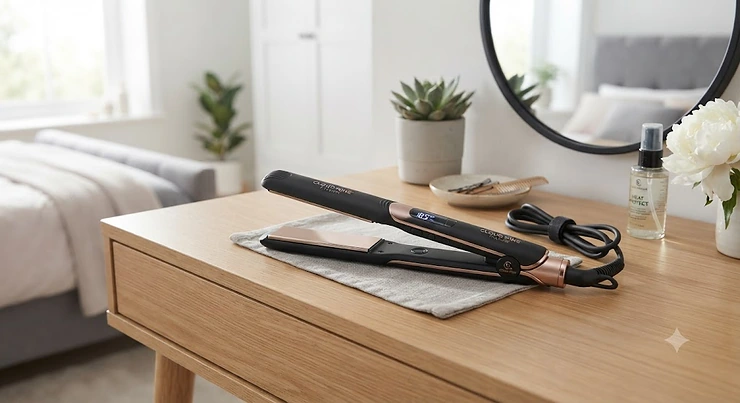
There is a particular kind of despair that only thick, coarse hair understands: you glide a straightener through a section, it looks flawless for exactly four seconds, and then it springs back into its natural shape like nothing happened. If that sounds familiar, the plates you are using are probably the problem, not your technique. titanium hair straighteners exist precisely for this scenario. They are styling tools with plates milled from titanium metal rather than ceramic, and because titanium conducts and holds heat far more efficiently than ceramic ever will, these irons reach higher, more stable temperatures in fewer passes.

Here is the 40-second version, because it deserves stating plainly before anything else: titanium hair straighteners use metal plates that heat up faster, run hotter, and recover temperature more quickly than ceramic alternatives, which makes them the better match for thick, coarse, curly, or chemically resistant hair. Ceramic still wins for fine or damage-prone hair, where a gentler, more even heat matters more than raw power.
This guide walks through seven real, currently available models, pulled from UK-facing retailers and genuine product listings rather than invented specs. Titanium is a metallic element prized in engineering for its strength-to-weight ratio and excellent thermal conductivity, and those same properties are exactly why plates milled from it conduct heat so efficiently, meaning styling tends to take noticeably fewer passes than with ceramic — and that single fact explains almost everything about who should buy one and who shouldn’t. Whether you’re chasing a professional titanium straighteners setup for salon-level keratin work or simply want something that will tame stubborn regrowth on a Tuesday morning, what follows is an honest, spec-led breakdown, not a rewritten product page.
Quick Comparison Table
Before the deep dive, here is how the seven models stack up at a glance. Every price shown is a rough band, not a fixed figure, because Amazon and other UK retailers adjust pricing constantly.
| Straightener | Plate Material | Max Temp | Best For | Price Range |
|---|---|---|---|---|
| BaByliss Titanium Hair Straightener | True titanium | 230°C | Budget titanium entry point | Under £35 |
| BaByliss PRO Nano Titanium ½” Flat Iron | Nano titanium | ~230°C | Short hair, root touch-ups | £45-£60 |
| BaByliss PRO Titanium Expressions Ultimate Styler | True titanium | ~230°C | Fine hair needing all-day hold | £50-£70 |
| Diva Pro Styling Ultra Fast Titanium | Floating titanium | 235°C | Best overall titanium plates | £90-£115 |
| Diva Pro Styling Precious Metals Touch (PRO202) | Titanium | 235°C | Salon and Brazilian Blow Dry work | £95-£120 range |
| CHI G2 Titanium Infused Ceramic | Titanium-infused ceramic | High heat, digital control | Infrared heat technology fans | £60-£90 |
| Nano Titanium Infrared 450°F Styler | Titanium, 3D floating | Up to 450°F (232°C) | Very coarse, resistant hair | £30-£45 |
Looking at the table, a clear pattern emerges: the further up the price ladder you climb, the more the straightener invests in heat recovery speed rather than just peak temperature. What most buyers overlook is that peak temperature is almost meaningless on its own; a straightener that hits 230°C but sags to 190°C mid-stroke on thick hair will underperform one that holds a steady 210°C throughout. The Diva Pro Styling Ultra Fast Titanium and the Diva Pro Styling Precious Metals Touch sit at the top of this table precisely because their floating titanium plates recover heat within seconds of contact, which matters enormously once you are three or four sections into a thick head of hair.
💬 Just one click — help others make better buying decisions too!😊
Top 7 Titanium Hair Straighteners: Expert Analysis
1. BaByliss Titanium Hair Straightener — best budget titanium entry point
This is the straightener most people meet first, and it earns its place by doing the one thing budget titanium models often fail at: actually using titanium plates rather than a titanium-flecked ceramic coating. The 30mm true-titanium plates run across five heat settings, from 150°C up to 230°C, giving you room to start conservatively and climb if your hair resists.
On paper this means genuinely fast heat transfer for the price bracket, and the active ionic conditioning is there to counter the static that titanium plates can generate on drier hair. Based on the spec comparison with rival budget ceramic irons, the advantage here is speed: fewer passes are needed to get hair lying flat, which matters if you are straightening a full head before work. This model is squarely aimed at buyers with thick or curly hair who don’t want to spend salon money to get salon-adjacent results, and it is noticeably less forgiving on fine, colour-treated hair, where the heat can feel aggressive even on lower settings.
Reviewers consistently report strong results on thick and afro-textured hair specifically, with several long-term users describing noticeably faster straightening compared with irons they’d previously tried, including specific praise for results on afro hair textures.
Pros:
- ✅ True titanium plates, not just a titanium coating
- ✅ Five heat settings covering 150-230°C
- ✅ Genuinely quick on thick or curly hair
Cons:
- ❌ 30mm plate width means more passes on very long hair
- ❌ Ionic function can’t fully offset flyaways on fine hair
Prices for this model tend to sit under £35, and at that price it remains one of the more honest titanium options on the market — you are not paying a premium for a brand story, just for functioning titanium plates.

2. BaByliss PRO Nano Titanium ½” Flat Iron — best for short hair and precision styling
The standout here is the slim ½-inch housing, built specifically for close, controlled work rather than sweeping through long lengths. This is a narrower, more surgical tool than most entries on this list, and that narrowness is the entire point.
The nano titanium plates are engineered to maintain stability at higher temperatures, which in practice means less of the temperature dip you get on cheaper irons when the plates clamp around a dense section of hair. Because the housing is so slim, it excels at pixie cuts, root touch-ups, and edging along a hairline where a full-size iron simply can’t get close enough. Here’s what to weigh: this is not a straightener built for volume; anyone with mid-back-length thick hair will find themselves doing three or four times the passes a wider iron would need.
Aggregated review sentiment for this line is mixed but instructive — some long-term BaByliss users have flagged inconsistent plate alignment on certain units, with a slight gap appearing toward the top of the plates rather than a perfectly flush meeting point, a manufacturing quirk worth checking for on arrival rather than a universal flaw.
Pros:
- ✅ Genuinely precise for short hair and edging
- ✅ Nano titanium plates hold temperature well
- ✅ Compact housing for tight styling angles
Cons:
- ❌ Too narrow for efficient full-length styling
- ❌ Some units reported uneven plate alignment
Expect to pay somewhere in the £45-£60 range, and treat this as a specialist second iron rather than an everyday primary tool for long or thick hair.
3. BaByliss PRO Titanium Expressions Ultimate Styler — best for fine hair chasing all-day hold
The rose-gold true-titanium plates on this model are the headline feature, and the “ultimate” naming isn’t just marketing bluster — this iron is genuinely built to squeeze more longevity out of a style than most competitors in its bracket.
Titanium’s rapid heat transfer means the cuticle is sealed almost instantly on contact, which is the mechanical reason styles from this iron tend to hold longer than ceramic equivalents at the same temperature. What most buyers overlook about titanium irons generally, and this one specifically, is that you often don’t need the maximum setting to get a lasting result; the plates are efficient enough that a mid-range heat will outperform a ceramic iron running flat out. This makes it a smart pick for people with fine-to-medium hair who still want titanium’s holding power without titanium’s reputation for harshness.
Reviewers frequently mention that styles from this iron survive a full day where their previous straightener’s results collapsed by lunchtime, with several long-term owners specifically praising the lack of hair pulling during use.
Pros:
- ✅ True titanium plates seal the cuticle fast
- ✅ Styles hold noticeably longer than ceramic irons
- ✅ Comfortable, low-snag glide reported by owners
Cons:
- ❌ Rose gold finish shows scuffs over time
- ❌ Not the widest plates for thick, long hair
Pricing typically lands between £50 and £70, positioning it as a genuine mid-tier alternative to bigger salon-brand names.
4. Diva Pro Styling Ultra Fast Titanium Professional Straightener — best titanium plates straighteners overall
This is the model that keeps coming up when UK salons talk about their daily-use tools, and the reason is the “Ultra Fast” heating system, which pushes both heat-up and heat recovery speed well beyond the brand’s older ranges.
The floating titanium plates run across sixteen manual settings between 90°C and 235°C, alongside pre-set hair-type programmes, and the headline figure worth understanding is heat recovery of roughly 8°C per second — meaning the plates barely dip in temperature even when clamped around a thick section. Based on the spec comparison with the rest of this list, that recovery speed is what separates a “fine” titanium iron from a genuinely professional titanium straighteners experience: it is the difference between one smooth pass and three frustrated ones. This is the straightener to reach for if you regularly do keratin or Brazilian Blow Dry-style treatments at home, since titanium’s mirror-smooth glide is specifically suited to sealing in those treatments.
One UK salon that uses this model as its daily workhorse reports that its wide plates take considerably bigger sections of hair than a standard styler, which translates into a noticeable difference on long or thick hair — fewer passes, faster styling, and a smoother overall finish. That is aggregated professional-use sentiment rather than a single customer review, and it lines up with the spec sheet.
Pros:
- ✅ Class-leading heat recovery speed (~8°C/sec)
- ✅ Sixteen manual settings plus hair-type presets
- ✅ Wide floating plates suit thick or long hair
Cons:
- ❌ Pricier than most high-street titanium options
- ❌ Some new users need a session to learn the touch controls
Expect a price range roughly between £90 and £115, which sits well below flagship Dyson or GHD pricing while offering comparable heat performance for coarse hair specifically.
5. Diva Pro Styling Precious Metals Professional Touch Straightener (Titanium, PRO202) — best for salon-grade coarse hair work
Where the Ultra Fast model is the daily workhorse, the Precious Metals Touch is the heavier-duty sibling, built with a noticeably more substantial housing and the same titanium floating plate philosophy pushed further toward professional endurance.
The plates run from 110°C to 235°C, and the design brief is explicit: mirror-like shine for glossy, salon-finished styles, and specific suitability for keratin and Brazilian treatments where any drag or unevenness ruins the result. What the spec sheet won’t tell you, but salon-side reports suggest, is that this iron is engineered for repeated, back-to-back client use across a working day rather than one morning styling session — the housing runs cooler to the touch and the heat-up curve is built for endurance rather than a single quick burst. For home users with genuinely coarse or resistant hair, that endurance translates into consistency: the fifth pass performs identically to the first.
Aggregated feedback highlights that some users switching from more expensive premium brands found this titanium model to be, in their words, “miles better” for thick, chemically treated hair, while a smaller number of buyers flagged inconsistent longevity between individual units — a legitimate quality-control point worth factoring into any purchase decision rather than dismissing.
Pros:
- ✅ Robust build designed for repeated daily use
- ✅ Wide 90-235°C-equivalent working range
- ✅ Strong reputation among working hairdressers
Cons:
- ❌ Heavier in the hand than slimmer titanium models
- ❌ A handful of durability complaints reported
Price typically ranges from around £95 to £120, which for a tool with genuine salon-floor use behind it represents reasonable long-term value rather than a premium markup for branding alone.
6. CHI G2 Titanium Infused Ceramic Flat Iron — best infrared heat technology pick
CHI built its reputation on far-infrared heat, and the G2 line folds that technology into a titanium-infused ceramic plate rather than a pure titanium one, which is worth understanding before you buy expecting identical performance to the pure-titanium models above.
The advanced ceramic heater reaches styling temperature quickly while layering in far-infrared heat and negative ions, a combination CHI designed specifically to protect the hair shaft while still styling efficiently. Here’s what that means in practice: far-infrared heat penetrates the hair shaft from the inside rather than only heating the surface, which theoretically reduces the surface-level scorching that pure high-heat titanium can cause on already-fragile ends. This makes the G2 a sensible middle-ground choice for anyone with coarse hair that is also colour-treated or previously damaged, where you want titanium-adjacent heat efficiency without titanium’s full intensity.
The infrared and negative-ion combination is CHI’s signature technology across its range, and it is the mechanism most consistently credited by users for reduced frizz and added shine compared with plain ceramic irons at equivalent settings.
Pros:
- ✅ Far-infrared heat targets the hair shaft, not just the surface
- ✅ Digital, colour-coded temperature control
- ✅ Gentler than pure titanium on compromised hair
Cons:
- ❌ Titanium-infused, not full titanium plates
- ❌ Dual-voltage import pricing can push it toward the top of budget
Depending on where it’s sourced, expect a price range of roughly £60 to £90, making it a solid mid-tier pick specifically for the infrared heat technology crowd.
7. Nano Titanium Infrared 450°F Professional Styler — best for very coarse, high-resistance hair
This is the straightener built for the small but real minority of buyers whose hair simply refuses to sit flat below a certain heat threshold. The adjustable range runs from 170°F right up to 450°F (roughly 232°C), covering everything from fragile hair on the low end to genuinely stubborn, resistant hair at the top.
The 3D floating plates combine nano titanium with far-infrared technology, and the design brief here is explicit about the audience: fragile, damaged or healthy hair on one button, with the same tool scaling up to thick, frizzy, or curly hair on another. Based on the spec comparison, the 450°F ceiling is the headline, but the more useful detail is the far-infrared layer working alongside it — infrared technology smooths the hair cuticle while the extreme end of the heat range does the mechanical work of holding a shape, which is precisely the pairing that matters for titanium straighteners 450 degrees searches. This is not a straightener for daily use on fine or previously bleached hair; it is a tool for occasional, deliberate use on hair that has defeated lower-heat irons before.
Reviewer sentiment on comparable nano-titanium infrared models in this heat bracket consistently flags the 30-second heat-up as a genuine convenience, alongside praise for the auto-off safety function, though some buyers note the swivel cord, while long, can feel bulky during use.
Pros:
- ✅ True 450°F ceiling for genuinely resistant hair
- ✅ Far-infrared layer alongside high heat
- ✅ Dual voltage, useful for travel
Cons:
- ❌ Too aggressive for fine or previously damaged hair
- ❌ 30-second heat-up is slower than premium titanium rivals
Price sits in a reasonably accessible £30-£45 range, which is worth noting given how few straighteners at this price point genuinely reach that top-end temperature with titanium plates behind it.
Top 7 Products at a Glance
| Straightener | Plate Width | Heat-Up Time | Ideal Hair Type |
|---|---|---|---|
| BaByliss Titanium Hair Straightener | 30mm | ~15 sec | Thick, curly |
| BaByliss PRO Nano Titanium ½” | 12.5mm | Fast | Short, precision |
| BaByliss PRO Titanium Expressions | Standard | Fast | Fine, needs hold |
| Diva Pro Styling Ultra Fast Titanium | Wide floating | ~20 sec to 180°C | Thick, keratin work |
| Diva Precious Metals Touch (PRO202) | Wide floating | Fast, sustained | Coarse, salon use |
| CHI G2 Titanium Infused Ceramic | 1″/1.25″ | Fast | Coarse + damaged |
| Nano Titanium Infrared 450°F | 1.5″ | 30 sec | Very resistant |
The clearest takeaway from this second table is that plate width and heat-up time pull in different directions depending on what you actually need. If you’re straightening a full head of thick hair every morning, the narrower, slower-heating BaByliss PRO Nano Titanium ½” will frustrate you regardless of how well it performs on a single section, while the Diva Pro Styling Ultra Fast Titanium and Diva Precious Metals Touch (PRO202) are specifically engineered to reward exactly that use case. For anyone chasing pure top-end heat, the Nano Titanium Infrared 450°F model remains the only entry here that genuinely reaches the far end of the temperature scale.
Practical Usage Guide: Getting the Most From Titanium Plates
Buying the right titanium straighteners is only half the job; using them correctly is what actually protects your hair while still getting a smooth result. The single biggest first-30-days mistake is starting at the highest available setting because “coarse hair needs maximum heat.” It doesn’t, not usually. Start at 180°C and only climb if hair resists after two clean passes — titanium’s superior heat transfer means you often need less total heat than a ceramic iron would demand for the same result.
Always apply a heat protectant spray before styling, and make sure hair is fully dry first; titanium plates run hot enough that residual moisture can effectively boil at the hair shaft, causing audible sizzling and real damage. Section hair into four to six manageable clumps rather than grabbing large handfuls — titanium’s fast heat transfer works best on modest sections passed through in one smooth, unhurried motion rather than several rushed attempts.
For maintenance, wipe the plates with a barely damp microfibre cloth once a week to remove product build-up, which otherwise bakes onto titanium’s smooth surface and gradually reduces glide quality. Store the iron in a heatproof pouch rather than tossing it into a drawer, since titanium plates are more resistant to scratching than ceramic but not immune to it, and a nicked plate surface will start snagging hair. Finally, resist the temptation to clamp and hold on stubborn sections — a slow, single continuous pass at the correct temperature will always outperform repeated re-clamping, which is where most avoidable heat damage actually happens.
✨ Don’t Miss These Exclusive Deals!
🔍 Take your hair styling routine to the next level with these carefully selected titanium straighteners. Click on any highlighted item to check current pricing and availability, and give your thick or coarse hair the smooth, salon-level finish it deserves!
Real-World Scenarios: Which Titanium Straightener Suits You
The thick-haired commuter styling before work: If you’re straightening a full head of naturally thick, wavy hair in under fifteen minutes every weekday, prioritise heat recovery over peak temperature. The Diva Pro Styling Ultra Fast Titanium or the budget-friendly BaByliss Titanium Hair Straightener both suit this rhythm, since neither sacrifices speed for a marginal temperature increase you won’t actually notice on a rushed morning.
The at-home keratin treatment user: If you’re investing in professional keratin or Brazilian Blow Dry products and want the styling step to match that investment, the Diva Pro Styling Precious Metals Touch (PRO202) is built specifically for this, with plates engineered for the mirror-smooth glide that seals in treatment products rather than dragging through them.
The fine-haired stylist chasing all-day hold: For genuinely fine hair that still needs a style to survive a twelve-hour day — think weddings, long shifts, or evening events straight after work — the BaByliss PRO Titanium Expressions Ultimate Styler offers titanium’s holding power without pushing the plates to an aggressive top-end heat that fine hair simply doesn’t need.
The occasional user with genuinely resistant hair: If lower-heat irons have consistently let you down and you only style once or twice a week, the Nano Titanium Infrared 450°F Professional Styler exists precisely for that frustration, combining a true high-heat ceiling with infrared technology to offset some of the surface stress that extreme heat otherwise causes.
How to Choose the Best Titanium Plates Straighteners
Choosing among titanium straighteners for thick coarse hair comes down to a short, honest checklist rather than marketing language:
- Match the temperature range to your actual hair, not your ideal hair. Fine or colour-treated hair rarely needs more than 200°C; genuinely coarse or Afro-textured hair may need the full 230-235°C range most titanium irons offer.
- Check plate width against your hair length. Wider plates (30mm+) suit long or thick hair by covering more per pass; narrower plates suit short styles and precision work.
- Prioritise heat recovery speed over peak temperature. A straightener that holds its heat through a thick section beats one that merely reaches a higher number on the display.
- Look for floating plates on thicker hair. Floating plates flex slightly to maintain even pressure and prevent the “kink line” that rigid plates can leave.
- Factor in ionic or infrared technology if frizz is your main issue. These features reduce static and smooth the cuticle surface, which matters more for texture than for raw straightening power.
- Consider heat-up time realistically. A straightener that takes 30 seconds to heat is a minor inconvenience for salon use but a genuine daily friction point for a rushed morning routine.
- Read aggregated review sentiment, not star ratings alone. A 4.5-star average can hide a specific, recurring complaint — plate alignment, cord length, or heat-up speed — that matters enormously for your specific hair type.
Titanium vs Ceramic: Which Wins for Coarse Hair Straightening
The honest answer, repeated by professionals across the UK styling industry, is “it depends on your hair,” and that isn’t a dodge — it’s the correct technical answer. Titanium simply heats up faster and reaches higher temperatures than ceramic, which is why it suits coarse, thick, or genuinely hard-to-straighten hair, while ceramic’s gentler, more even heat distribution remains the safer choice for fine or already-damaged hair.
| Factor | Titanium | Ceramic |
|---|---|---|
| Heat-up speed | Very fast | Moderate |
| Heat conductivity | Excellent | Good |
| Best hair type | Thick, coarse, curly | Fine, fragile, colour-treated |
| Plate durability | Very scratch-resistant | Prone to chipping/wear |
| Risk of damage if misused | Higher | Lower |
What this table doesn’t capture on its own is the interaction between heat and hair porosity. Coarse hair typically has a thicker cuticle layer, meaning titanium’s aggressive heat transfer is actually necessary to penetrate and reshape the internal hydrogen bonds — the same mechanism ceramic simply can’t achieve as quickly. On fine or previously bleached hair, however, that same aggressive transfer becomes a liability, stripping moisture faster than the hair can tolerate. The practical rule most stylists apply: if your hair takes two or more passes with a quality ceramic iron to hold a style, titanium is very likely worth the switch.
Beauty editors who’ve tested dozens of irons tend to land on the same simple observation: metal plates, usually titanium, heat up within seconds and cost a little more, but they earn that premium on hair thick or coarse enough to need several attempts with a standard iron. That single point sums up the entire category better than most marketing copy manages to.
Professional Titanium Straighteners: Salon-Grade vs High Street
The gap between a £25 titanium iron and a £120 professional titanium straighteners model isn’t just branding — though branding plays a role — it’s almost entirely about consistency under sustained use. A salon stylist might straighten fifteen heads of hair in a single day, each one demanding the plates recover their temperature within seconds, repeatedly, for eight hours straight. High-street irons are rarely engineered for that punishment; their heating elements are sized and priced for a single daily use, not continuous professional throughput.
That’s the practical difference buyers are actually paying for when they choose something like the Diva Pro Styling Precious Metals Touch (PRO202) over a supermarket-shelf titanium iron: not a different plate material, necessarily, but a heating system built to hold its performance across dozens of consecutive passes rather than degrading after the fifth one. For home users, this matters less in absolute terms, but it does explain why professional-grade models tend to feel noticeably more consistent on the fourth or fifth section of hair, where a cheaper iron has already started losing ground.
It’s also worth noting that “professional” on a product label isn’t a regulated term in the UK the way it might be for other product categories — it signals the manufacturer’s intended market, not a certified performance standard, so the spec sheet still matters more than the word itself.
High Heat Titanium Plates and the 450°F Question: What to Expect
A genuine 450°F (roughly 232°C) ceiling sounds impressive on a spec sheet, but the real-world question is whether your hair will ever actually need it. For most coarse or thick hair, the sweet spot sits closer to 200-220°C; the extra headroom up to 450°F exists for a specific minority — very tightly coiled, chemically resistant, or previously relaxed hair that genuinely won’t hold a shape below that threshold.
What the spec sheet won’t tell you is that using the top of that range as a default, rather than a last resort, accelerates protein damage in the hair shaft considerably faster than the difference between, say, 200°C and 220°C would. Reviewers consistently note that high heat titanium plates work best in short, decisive passes at the top setting rather than lingering, slower strokes — the goal is contact time measured in a second or two, not five or six. If you find yourself needing the full 450°F setting on every single section, that’s usually a sign the hair needs more preparation (thorough drying, a heat protectant built for high heat, or smaller sections) rather than more raw temperature.
Infrared Heat Technology Explained: Does It Actually Work
Infrared radiation is simply a band of the electromagnetic spectrum with a longer wavelength than visible light, and it’s this wavelength that allows it to penetrate materials, including hair, more deeply than surface contact heat alone. Infrared heat technology, as used in models like the CHI G2 Titanium Infused Ceramic and the Nano Titanium Infrared 450°F Professional Styler, works on a genuinely different mechanism to standard plate contact heat. Rather than only heating the hair’s surface through direct contact, infrared wavelengths work their way into the hair shaft from within, while the outer titanium or ceramic surface handles the mechanical straightening. In plain terms, the plate does the shaping work while the infrared layer works from within the strand, which in principle reduces the surface-level scorching that pure high-contact heat alone can cause.
This doesn’t mean infrared irons are risk-free at high settings — physics doesn’t work that way — but it does mean two irons set to the same displayed temperature can produce meaningfully different amounts of surface stress if one incorporates infrared and the other doesn’t. For buyers specifically searching out infrared heat technology, the realistic expectation should be modestly reduced surface damage and improved shine retention, not a magic exemption from heat damage altogether. Combined with a genuine heat protectant, it’s a reasonable middle path for coarse hair that also happens to be colour-treated or otherwise compromised.
Safety, Regulations & Buying Compliance in the UK
Hair straighteners are a genuinely underrated fire and burns risk in UK homes, and titanium models — which run hotter and recover heat faster than ceramic — deserve extra care rather than less. UK safety guidance is clear that mains-operated straighteners must be fitted with a proper UK three-pin plug and fuse, and should always be unplugged when not in use rather than left idle but powered. Always buy from a reputable retailer rather than an unverified third-party seller, since counterfeit units are less likely to have passed proper UK safety testing.
Look for the CE or UKCA mark on the packaging, which confirms the product meets UK and EU electrical safety standards, and register your straightener with the manufacturer where possible — this makes it far easier to be contacted in the rare event of a safety recall. Given that titanium plates hold heat for longer after switch-off than ceramic ones, always let the iron cool fully on a heatproof mat or in its supplied pouch before packing it away, and never leave a plugged-in straightener unattended, even briefly. You can find comprehensive, up-to-date UK guidance on this from Electrical Safety First’s dedicated hair straighteners advice page, which is worth bookmarking regardless of which model you choose.
If you want a deeper, independently tested comparison across brands and budgets before committing, Which?’s hair straightener buying guide is one of the more rigorous UK resources available, covering everything from heat accuracy testing to damage assessment under a microscope.
Frequently Asked Questions
❓ Are titanium straighteners better than ceramic for thick hair?
❓ What temperature should I use titanium straighteners at for coarse hair?
❓ Can titanium straighteners damage fine or colour-treated hair?
❓ How long do titanium hair straighteners typically last?
❓ Do titanium straighteners work for keratin or Brazilian Blow Dry treatments?
Conclusion
Titanium hair straighteners are not a universal upgrade over ceramic; they are a specific tool for a specific problem, and that problem is hair that simply won’t hold a style under gentler heat. For thick, coarse, curly, or chemically resistant hair, the faster heat transfer and higher achievable temperatures of titanium plates translate directly into fewer passes, less repeated heat exposure, and a style that survives longer than ceramic can typically manage at the same setting.
Of the seven models covered here, the BaByliss Titanium Hair Straightener remains the most sensible entry point if you’re testing whether titanium suits your hair at all, while the Diva Pro Styling Ultra Fast Titanium and Diva Pro Styling Precious Metals Touch (PRO202) represent the more serious end of the category for anyone doing regular keratin work or simply wanting salon-level consistency at home. If infrared technology or a genuine 450°F ceiling matters more to your specific hair texture, the CHI G2 Titanium Infused Ceramic and Nano Titanium Infrared 450°F Professional Styler cover that ground convincingly.
Whichever you choose, the underlying advice doesn’t change: match the temperature to your actual hair rather than the highest number on the dial, use a proper heat protectant every time, and treat the safety guidance around these genuinely hot appliances with the seriousness it deserves. Get that right, and titanium’s reputation as the tool for difficult hair will make a lot more sense within the first use.
✨ Ready to find your match? Compare the seven picks above and pick the titanium straightener built for your actual hair type, not just the highest star rating.
Recommended for You
- Ceramic vs Titanium Straighteners: 7 Best Picks Tested 2026
- Ceramic Hair Straighteners: 7 Best Picks That Won’t Wreck Your Hair (2026)
- GHD vs Cloud Nine Straighteners: 7 Best Picks Tested for 2026
Disclaimer: This article contains affiliate links. As an Amazon Associate, I earn from qualifying purchases. If you purchase products through these links, we may earn a small commission at no additional cost to you.
✨ Found this helpful? Share it with your friends! 💬🤗
