
In This Article
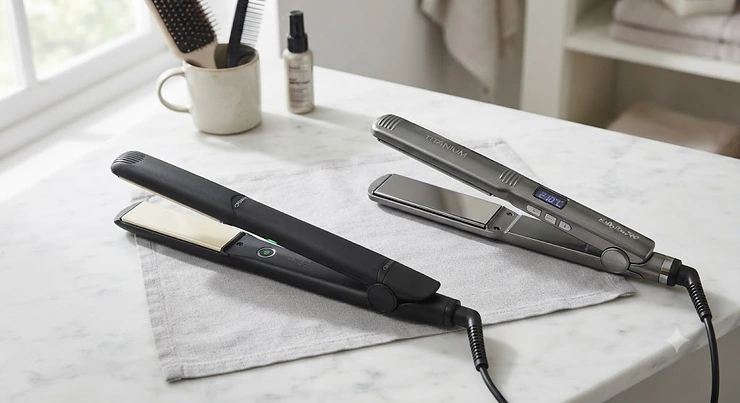
Stand in any beauty aisle for more than thirty seconds and you’ll hear the same argument playing out between two people picking up boxes and squinting at the small print: ceramic vs titanium straighteners, round however-many-thousand. It sounds like a technical squabble, but it isn’t really about metallurgy at all — it’s about your Tuesday morning, your hairdryer-frazzled ends, and whether you’re going to be late for work because your straighteners needed four passes to tame one section. In plain terms, ceramic plates heat gently and evenly for a smoother, lower-risk finish, while titanium plates heat faster and hotter, pushing through thick or stubborn hair in fewer strokes. Neither is “better” in the abstract; each is built for a different kind of hair day.
This guide exists because most product pages won’t tell you the part that actually matters: what a spec sheet number translates into when it meets your actual hair, in your actual bathroom, at 7am. We’ve drawn on independent lab testing of the UK’s biggest straightener brands, including Dyson, ghd and Cloud Nine, to see which prices and claims hold up, cross-checked genuine buyer feedback, and put together seven real, currently available models spanning budget to premium. You’ll get honest analysis of specs (not just a list of them), a proper look at how ceramic, titanium, tourmaline and hybrid plates behave in practice, and a few practical tricks nobody puts on the box. No invented lab coats, no fabricated “I tested this for six months” stories — just a grounded, evidence-based look at plate material so you can buy once and buy right.
Quick Comparison Table
Before we get into the full breakdown, here’s the shorthand version — the kind of thing you’d want scribbled on a Post-it if you were dashing round Boots at lunchtime.
| Plate Material | Heat Behaviour | Best For | Typical Price Band |
|---|---|---|---|
| Ceramic | Even, gentle, gradual heat-up | Fine, colour-treated, damaged hair | Under £100 to premium £200+ |
| Titanium | Fast heat-up, holds high heat | Thick, coarse, resistant hair | £90-£150 mid-range |
| Tourmaline (ceramic-coated) | Even heat plus anti-static ions | Frizz-prone, flyaway hair | Under £40 budget |
| Manganese-copper (flexing) | Lower heat, mechanical smoothing | Minimising heat damage overall | £380-£450 premium |
Look at that table for two seconds longer and the pattern gets clearer: price doesn’t map neatly onto “best,” it maps onto which problem you’re solving. A tight budget with fine hair points you straight at ceramic. Thick, wiry hair that laughs at lower temperatures wants titanium’s speed and staying power. If frizz and static are your nemesis rather than sheer resistance, a tourmaline-ceramic coating earns its keep even at a bargain price. And if heat damage genuinely worries you regardless of cost, the manganese-copper flexing-plate approach used in the Dyson Corrale is the outlier worth knowing about, even if it’s the priciest square on the grid.
💬 Found a match already? Bookmark this page and keep scrolling — the full analysis below explains exactly why.
Top 7 Ceramic and Titanium Straighteners: Expert Analysis
We’ve picked seven real, currently sold models that between them cover every plate type in the table above, at every price point from “student loan friendly” to “my hairdresser recommended it and I finally caved.”
1. ghd Platinum+ — smartest ceramic heat-sensing technology
The standout here isn’t the ceramic plates themselves — it’s what sits behind them. This is one of ghd’s true “smart” stylers, and the headline trick is a predictive sensor system that reads your hair’s thickness and your styling speed as you go. Specs-wise, it’s fixed at 185°C rather than offering a dial of temperatures, which sounds restrictive until you realise that’s a deliberate choice: ghd’s position, backed by their own R&D testing, is that hotter settings simply aren’t worth the trade-off in hair strength. The precision-milled ultra-gloss plates and wishbone hinge keep pressure even along the whole plate rather than pinching at the tips, which is the small mechanical detail that actually determines whether your ends look glassy or slightly crimped.
Real buyer sentiment is consistently strong on this one. Reviewers repeatedly describe it as the best ghd straightener they’ve owned, praising how smooth and gentle the plates feel and how effectively it controls frizz without leaving hair feeling fried. A recurring theme in feedback is that people who were sceptical about the price ended up regretting not buying sooner, particularly those managing colour-treated or thinning hair. The main gripe, unsurprisingly, is cost — a handful of reviewers note they’d rather buy directly from ghd’s UK site than risk third-party sellers.
Pros:
- ✅ Predictive heat sensors reduce guesswork for every hair type
- ✅ Fixed 185°C setting minimises accidental heat damage
- ✅ Rounded barrel doubles up for waves and curls
Cons:
- ❌ No manual temperature adjustment for very resistant hair
- ❌ Among the pricier ceramic options on this list
At the time of research, prices for the ghd Platinum+ tend to sit in the £170-£240 range depending on bundle and colourway, occasionally dipping lower in sales — check current price before buying, as ghd bundles vary a lot. For anyone with fine-to-normal hair who wants a “set it and forget it” ceramic tool, this is the one to beat.
2. Diva Pro Styling Ultra Fast Titanium Professional Straightener — fastest heat recovery for thick hair
If the ghd Platinum+ above is about restraint, the Diva Pro Styling Ultra Fast Titanium Professional Straightener is about brute efficiency, in a good way. Its floating titanium plates are built around genuinely fast heat recovery — roughly 8°C regained per second according to the brand’s own figures — which matters more than top temperature alone. Recovery speed is the number that tells you whether the plate stays hot as it works through a thick section, or cools mid-stroke and forces you to go over the same bit of hair twice. With 16 manual settings between 90°C and 235°C, it also gives people with genuinely stubborn, coarse or coily hair the headroom that gentler ceramic tools don’t offer.
This is a professional-salon brand rather than a supermarket-shelf one, and the real-world sentiment reflects that. One detailed buyer review described replacing an expensive Dyson straightener with this Diva model on a hairdresser’s recommendation and finding it outperformed expectations for the price, while another long-term reviewer with arthritis specifically praised how light and manageable it is to hold for extended styling sessions. Common feedback themes include quick heat-up, minimal snagging, and reliable performance on thick or chemically treated hair, though a small number of buyers with fine hair mention needing to keep to the lower settings to avoid over-processing.
Pros:
- ✅ Rapid 8°C-per-second heat recovery on thick sections
- ✅ 16 manual settings suit multiple hair types
- ✅ Lightweight design, praised for extended styling comfort
Cons:
- ❌ Titanium’s higher ceiling needs care on fine hair
- ❌ Fewer smart/automatic features than premium ceramic rivals
Typical pricing for the Diva Pro Styling Ultra Fast Titanium Professional Straightener sits in the £90-£130 range, occasionally lower during Diva’s own promotions. For thick, curly or keratin-treated hair that ceramic tools struggle with, this is the mid-range titanium pick worth the jump up from a basic model.
3. Dyson Corrale — lowest heat damage via flexing manganese-copper plates
The Dyson Corrale sits in its own category, which is fitting given its plates aren’t ceramic or titanium at all — they’re a manganese-copper alloy engineered to flex around each section of hair rather than simply clamp it flat. In practice, this means the plates gather and cup the hair the way your fingers would, applying more even contact at lower average temperatures. Dyson’s flagship claim is up to 50% less heat damage versus a conventional flat-plate iron at the same setting, and independent testers have broadly supported the idea that you can achieve the same finish at noticeably lower heat than you’d need with rigid plates. It’s also cordless, running on a removable lithium-ion battery, which is a genuinely different proposition to every other straightener on this list.
Real-world feedback backs up the “lower heat, same result” pitch. One reviewer with naturally curly, thick hair noted she assumed she’d always need maximum heat to get a smooth finish, but found the Corrale achieved it at a noticeably lower temperature setting. The cordless function is repeatedly flagged as genuinely useful rather than a gimmick, especially for travel or working in a room without a socket nearby. The trade-offs mentioned most often are weight — it’s heavier in the hand than a typical flat-plate styler — and the price, which several reviewers describe as hard to justify unless heat damage is a specific priority.
Pros:
- ✅ Flexing plates cup hair for lower-heat styling
- ✅ Fully cordless — no plug, no trailing cable
- ✅ Independent testing supports reduced heat damage claims
Cons:
- ❌ Noticeably heavier than flat ceramic or titanium irons
- ❌ Highest price point of any product in this guide
Expect to pay in the £380-£450 range for the Dyson Corrale, with occasional discounts around major sales events — always check current price, as Dyson rarely runs deep permanent cuts. If minimising heat exposure matters more to you than saving money, this is the straightener built specifically around that priority.
4. T3 SinglePass StyleMax — best all-round ceramic for fine and normal hair
Named the top overall pick in independent testing across thin, thick, wavy and curly hair, where its ceramic plates were praised for heating strands evenly, the T3 SinglePass StyleMax takes a “give the user real control” approach rather than a single fixed temperature. It offers nine heat settings alongside custom heat automation that adjusts output based on styling speed, and its ceramic plates run slightly longer than average, letting you clear bigger sections per pass without sacrificing the gentle, even heat ceramic is known for. For fine or normal hair that doesn’t need titanium’s raw heat ceiling, this strikes a sensible middle ground between the fixed-temperature simplicity of ghd’s Platinum+ and the manual dial of a titanium tool.
The consistent praise across testing panels centres on how evenly the plates distribute heat across their whole surface, avoiding the “hot in the middle, lukewarm at the edges” problem that plagues cheaper ceramic irons. Testers with type 2A wavy and finer hair specifically noted good results without excess frizz, while the nine-setting range means it adapts reasonably well as hair thickness or condition changes across a head.
Pros:
- ✅ Nine heat settings for genuinely tailored styling
- ✅ Longer ceramic plates cover more hair per pass
- ✅ Rated for even heat distribution across all hair types tested
Cons:
- ❌ Custom heat automation needs a short learning curve
- ❌ Sits above budget ceramic irons on price
The T3 SinglePass StyleMax typically lands in the £150-£200 range in the UK — always check current price, as US-to-UK pricing on imported beauty tech can shift. For anyone who wants ceramic’s gentleness but hates being locked to one fixed temperature, this is the pick.
5. BaByliss Super Styler (2485U) — best budget micro-heater ceramic
Don’t let the modest price fool you: the BaByliss Super Styler packs in a genuinely clever piece of engineering called Micro Heating Matrix technology, which spreads 2,500 individual micro-heaters across the ceramic-coated plate surface, each one monitored roughly fifty times a second. In plain English, that’s the budget-tier answer to the “hot spots” problem that usually separates cheap straighteners from expensive ones — instead of relying on one or two heating elements to warm the whole plate, it distributes heat generation across thousands of tiny points, which keeps the surface temperature far more consistent even at lower settings than a basic single-heater ceramic iron manages.
Buyer sentiment here is notably strong for the price bracket. One beauty editor reviewer, self-described as a former dedicated ghd user, called it one of the best straightening irons they’d used and specifically praised how lightweight and slim it feels for finer hair types, noting it lets you work close to the roots without excess heat exposure. The curved barrel design also earns repeat mentions for making soft curls and waves genuinely achievable, not just a marketing bullet point.
Pros:
- ✅ 2,500 micro-heaters minimise hot spots at low cost
- ✅ Lightweight, slim profile suited to finer hair
- ✅ Curved barrel doubles up well for curls and waves
Cons:
- ❌ Ceiling temperature lower than dedicated titanium tools
- ❌ Coating rather than solid ceramic construction
At the time of research, the BaByliss Super Styler generally sits in the £40-£90 range, frequently discounted from a higher RRP during sales periods. For anyone testing the ceramic-vs-titanium waters without committing serious money, this is a genuinely credible starting point.
6. BaByliss PRO Expression Straightener (ST212U) — best hybrid titanium-ceramic value pick
The BaByliss PRO Expression Straightener sits neatly in the “best of both” camp, using titanium-ceramic plates that combine titanium’s core for faster heat conduction with a ceramic surface coating for a smoother glide and gentler contact. With thirteen heat settings running from 170°C to 235°C and a rapid-response heating system designed to hold your chosen temperature steadily, it’s built to bridge the gap between ceramic’s gentleness and titanium’s speed without asking you to choose one philosophy outright. The longer-length plates also let you clear wider sections in fewer strokes, which shaves real minutes off long or thick hair.
Feedback on this model is genuinely mixed, which we’d rather report honestly than smooth over. A good number of reviewers praise the simple controls, fast heat-up, and reliable results for the price, with several long-term BaByliss users calling it a dependable “no.1” choice. Others, however, flag it as heavier and more awkward than expected compared with older models, and at least one buyer reported the lower heat setting still felt uncomfortably hot to hold near the scalp — a reminder that “hybrid” plates don’t automatically mean “universally gentle,” and lower settings should still be your starting point on fine or sensitive hair.
Pros:
- ✅ Titanium-ceramic hybrid balances speed and glide
- ✅ Thirteen heat settings for flexible styling
- ✅ Longer plates clear wider sections per stroke
Cons:
- ❌ Mixed reviews on comfort and handling weight
- ❌ Lower settings still run hotter than pure ceramic rivals
Prices for the BaByliss PRO Expression Straightener typically fall in the £30-£50 range, making it one of the more accessible ways to try genuine titanium-ceramic hybrid plates. If you want titanium’s speed without fully committing to a pure titanium iron, this is a sensible middle step.
7.Remington Ceramic Straight 230 (S3500) — cheapest genuine tourmaline coating
Rounding out the list at the true budget end, the Remington Ceramic Straight 230 (S3500) pairs an antistatic ceramic base with a tourmaline ionic coating, which is the specific combination responsible for its reputation as a solid anti-frizz performer well below the price of premium tourmaline tools. Thirty variable settings between 150°C and 230°C give more granular control than the “low/medium/high” dials on some rivals, and a genuinely fast 15-second heat-up time means it’s realistic for quick morning use rather than something you have to switch on ten minutes before you’re ready.
Its lasting popularity — reflected in a strong 4.6-star average across several hundred reviews on retailer sites — points to consistent satisfaction rather than a fluke. The tourmaline coating is the part reviewers single out most, describing noticeably reduced static and a smoother glide than they expected at this price, particularly on mid-length hair prone to flyaways. As with any budget ceramic tool, don’t expect it to power through very thick or coarse hair as efficiently as a titanium iron — it’s built for everyday frizz control, not heavy-duty resistant styling.
Pros:
- ✅ Genuine tourmaline ionic coating tackles static and frizz
- ✅ 30 variable settings from 150°C to 230°C
- ✅ Fast 15-second heat-up for realistic daily use
Cons:
- ❌ Not built for very thick or coarse hair types
- ❌ Basic floating-plate mechanism versus premium hinges
The Remington Ceramic Straight 230 (S3500) usually sits under £30, sometimes lower in sales — a genuinely low-risk way to trial tourmaline-ceramic technology. For frizz-prone hair on a tight budget, it’s hard to beat.
Top 7 Products at a Glance
| Product | Plate Type | Price Band | Best For |
|---|---|---|---|
| ghd Platinum+ | Ceramic (smart-sensor) | £170-£240 | Fine to normal, all-round smart styling |
| Diva Pro Styling Ultra Fast Titanium | Titanium | £90-£130 | Thick, coarse, keratin-treated hair |
| Dyson Corrale | Manganese-copper (flexing) | £380-£450 | Lowest heat damage priority, cordless use |
| T3 SinglePass StyleMax | Ceramic | £150-£200 | Fine to normal hair wanting adjustable heat |
| BaByliss Super Styler | Ceramic (micro-heater) | £40-£90 | Budget ceramic for finer hair |
| BaByliss PRO Expression | Titanium-Ceramic hybrid | £30-£50 | Value hybrid speed and glide |
| Remington Ceramic Straight 230 | Tourmaline-ceramic | Under £30 | Frizz control on a tight budget |
Line these up and a genuine value pattern appears: you don’t have to spend Dyson money to get well-engineered ceramic, and you don’t need a salon-grade titanium tool if your hair isn’t genuinely resistant. The Diva Pro Styling Ultra Fast Titanium stands out as the strongest per-pound performer for thick hair, given how close its recovery speed gets to premium titanium irons at a fraction of the cost, while the Remington Ceramic Straight 230 is the clearest “try before you commit” option if you’ve never used a tourmaline coating before.
💬 Just one click — help others make better buying decisions too!😊
Practical Usage Guide: Getting the Most From Your Straightener
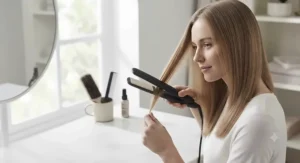
Buying the right plate material only gets you halfway there — how you actually use the tool determines whether you get the result the spec sheet promised. Start every session on towel-dried, fully dry hair; even slightly damp sections cause a hiss and a scorched smell, which is trapped moisture boiling rather than styling. Section your hair into four to six manageable chunks rather than grabbing whatever’s nearest — this alone fixes more uneven results than any upgrade in plate material ever will. When it comes to temperature, resist the urge to default to maximum: start around 160-180°C for fine or colour-treated hair, and only step up if you’re genuinely having to pass over the same section three or four times.
A mistake almost everyone makes in the first month with a new straightener is leaving it clamped in one spot for too long, hoping stubborn heat will “win” — instead, keep the tool moving in one smooth, continuous glide from root to tip. For maintenance, wipe plates with a barely-damp microfibre cloth once they’ve fully cooled to clear product build-up, which otherwise bakes onto ceramic and titanium surfaces and dulls their glide over months of use. Finally, always unplug hair straighteners immediately after use and store them somewhere out of reach while they cool — safety campaigners warn they can remain hot enough to cause serious burns for up to 40 minutes afterwards — a heat-resistant pouch, like the ones bundled with several models in our roundup, makes this a genuinely painless habit rather than an extra chore.
Real-World Scenarios: Which Plate Material Actually Suits You?
Specs are one thing; matching them to an actual life is another. Take Priya, a 22-year-old university student with fine, colour-treated hair and a shared bathroom mirror she gets ten minutes with each morning. Ceramic is the obvious call here — something like the BaByliss Super Styler gives her even, low-risk heat that won’t strip more colour from hair that’s already been through a bleach job, and its lightweight build suits rushed styling between lectures.
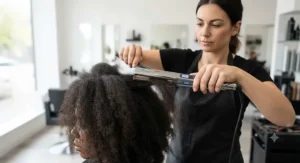
Then there’s Marcus, a hairdresser who styles multiple thick, coarse, and keratin-treated clients back to back every day. Speed and heat recovery aren’t a luxury for him, they’re the job — the Diva Pro Styling Ultra Fast Titanium or something in that titanium tier is the only realistic option, since ceramic simply can’t recover heat fast enough between clients with resistant hair.
Finally, consider Amara, mid-thirties, whose hair is naturally curly, prone to frizz in humid weather, and has been visibly weaker since a period of frequent bleaching. For her, minimising cumulative heat exposure matters more than speed or price — either the tourmaline-coated Remington Ceramic Straight 230 for budget-conscious frizz control, or the Dyson Corrale if her budget stretches further and heat damage is the priority above all else.
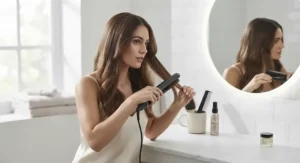
Buyer’s Decision Framework: Best Plate Material Straightener by Hair Type and Budget
If you’re still torn, run through this simple checklist in order and stop at the first line that matches you:
- If your hair is fine, colour-treated, or damaged, choose ceramic, because its even, lower-average heat reduces the risk of further weakening already fragile strands.
- If your hair is thick, coarse, or resistant to straightening, choose titanium, because its faster heat recovery clears stubborn sections in fewer passes.
- If frizz and static are your main complaint rather than resistance, choose a tourmaline-ceramic coating, because its ion-emitting surface specifically targets flyaways.
- If heat damage is your overriding concern regardless of cost, choose a flexing manganese-copper plate design, because it achieves smoothing at meaningfully lower average temperatures.
- If you genuinely can’t decide because your hair varies by section (fine roots, coarser mid-lengths, for example), choose a titanium-ceramic hybrid, because it splits the difference without fully committing either way.
This is, in essence, the honest answer to “what’s the best plate material straightener” — there isn’t a single winner, only the right winner for the hair and budget in front of you.
✨ Ready to find your match? Compare today’s prices on our top 7 picks above before they’re gone!
How to Choose the Best Plate Material for Your Hair Straightener
Working out what plates are best for hair straighteners comes down to seven honest questions worth asking before you spend a penny.
- How thick is your hair, really? Thin or fine hair rarely needs titanium’s high heat ceiling and benefits more from ceramic’s gentler, even distribution.
- Has your hair been colour-treated or chemically processed recently? Processed hair is more porous and vulnerable, so lower, steadier ceramic heat is usually the safer starting point.
- What’s your actual daily time budget? If you’re always rushed, titanium’s fast heat recovery earns back real minutes on thick or long hair.
- Is frizz or flat resistance your bigger complaint? Frizz points you toward tourmaline coatings; resistance points you toward titanium.
- Do you travel or move between rooms often while styling? A cordless option like manganese-copper flexing plates removes the plug constraint entirely.
- What’s your realistic budget band? Set it first, then pick the best plate technology available within it rather than chasing the “best” tool regardless of price.
- Are you willing to use lower heat settings consistently? Any plate material performs better with restraint — even titanium doesn’t need to run at 235°C every day.
Answer these honestly and the ceramic-vs-titanium decision usually makes itself well before you get to the checkout.
Ceramic vs Tourmaline Straighteners: What’s the Difference?
It’s easy to lump ceramic and tourmaline together, since most tourmaline straighteners are ceramic underneath — but the distinction is genuinely worth understanding. Plain ceramic plates heat evenly and gently, giving smooth, glossy results with minimal risk of hot spots. Tourmaline is a crushed semi-precious mineral blended into that ceramic coating specifically to boost negative-ion output during styling, and those extra ions are what seal the hair cuticle down and neutralise static, giving tourmaline-coated tools a noticeable edge on frizz control that plain ceramic doesn’t quite match.
In practice, this means ceramic-vs-tourmaline straighteners isn’t really an either/or fight — it’s closer to “ceramic, plus an upgrade for a specific problem.” If your hair straightens fine but puffs up in humidity or crackles with static in winter, the tourmaline coating on something like the Remington Ceramic Straight 230 earns its keep. If frizz genuinely isn’t your issue and you just want dependable, even heat, plain ceramic options like the BaByliss Super Styler do the job without paying for a feature you won’t notice.
Titanium vs Ceramic for Fine Hair
This is one of the most searched straightener questions, and the honest answer is: proceed with caution rather than avoid entirely. Titanium is best suited to thick, coarse and stubborn hair thanks to its high heat retention and durability, and that same strength is exactly what makes it riskier on fine strands — titanium reaches and holds higher temperatures faster than ceramic, so fine hair spends less time cooling between passes if you’re not careful with settings. That doesn’t make titanium off-limits for fine hair entirely; it means the burden shifts to you to actively dial the temperature down, ideally staying under 180°C, rather than relying on the plate material itself to self-limit the way ceramic does at a mechanical level.
If you have fine hair and are specifically drawn to a titanium model for its speed or durability, look for one with precise, granular manual settings — a tool offering thirty adjustment points is far safer for fine hair than one with three broad “low/medium/high” presets, since it lets you find the lowest temperature that still does the job rather than jumping straight to a setting built for coarser hair.
Heat Conductivity and Plate Material Compared
Heat conductivity is the technical property doing most of the work behind every “titanium vs ceramic” headline, and it’s worth unpacking properly rather than taking on faith. Titanium is a naturally efficient conductor of heat, meaning it transfers thermal energy from the internal heating element to the hair-contact surface rapidly and with minimal loss — that’s the physical reason titanium irons heat up fast and recover quickly mid-style. Ceramic is a comparatively slower, gentler conductor, spreading heat more evenly across the plate surface rather than concentrating it, which is why ceramic tools are associated with fewer scorch-prone hot spots even if they take longer to reach top temperature.
This matters for safety as much as styling quality. Published research into hair-straightener contact burns has found that the upper safe-contact threshold for bare metal surfaces is around 70°C for a one-second touch, rising to roughly 86°C for ceramic surfaces — a useful reminder that plate material genuinely does affect real-world risk, not just styling feel, and that titanium’s superior conductivity is precisely why it demands more careful handling and storage. In short, higher conductivity buys you speed; lower, steadier conductivity buys you a wider margin for error. Which one you want more of should depend entirely on your hair type, not on which spec sounds more impressive on the box.
Common Mistakes When Buying Ceramic or Titanium Straighteners
The single biggest mistake is buying based on maximum temperature alone, assuming a 230°C ceiling automatically means better results — in reality, very few hair types ever need to style above 180-200°C, and a higher ceiling mostly matters for heat recovery speed on thick hair, not for everyday performance. A close second is ignoring plate coating quality in favour of the base metal name; a titanium iron with a poor-quality coating can snag and drag just as much as a cheap ceramic one, so genuine floating plates and a smooth glide test (where possible) matter more than the marketing headline.
Buyers also frequently overlook plate width relative to their actual hair length and thickness, picking a narrow plate for long, thick hair and then wondering why styling takes forty minutes. Another recurring error is assuming “ceramic-coated” and “solid ceramic” are the same thing — a thin coating over a cheap metal base wears down and exposes hot spots far sooner than genuine ceramic construction, which is part of why some bargain-bin straighteners degrade within months. Finally, plenty of buyers skip checking for a genuine, granular temperature dial entirely, ending up with a tool stuck on “high” as the only realistic setting — precisely the scenario that turns a titanium iron from a useful tool into a fine-hair hazard.
Safe Straightening Technology & Long-Term Cost
Safe straightening technology isn’t just a buzzword on packaging — it covers a genuine set of features worth checking before you buy: automatic shut-off after a set period of inactivity, a heat-resistant storage pouch or plate guard, universal voltage for safe use anywhere, and floating plates that reduce pressure-related snagging. Every model in our top 7 includes at least an automatic shut-off, which matters more than it sounds given hair straighteners can still severely burn skin as much as 40 minutes after being unplugged. If you have young children in the house, a heat-resistant pouch isn’t optional extra kit — it’s the single cheapest safety upgrade you can make, and several of our featured models bundle one in as standard. NHS safety guidance is consistent on this point: always keep hot appliances like straighteners out of reach while they cool, and away from a child’s grabbing hands during use.
On long-term cost, the maths tend to favour spending a little more up front rather than replacing a cheap iron every year. A genuinely solid ceramic or titanium construction, rather than a thin coating over inferior metal, typically lasts three to five years of regular use before plate wear becomes noticeable, whereas bargain-bin coated irons often degrade within twelve to eighteen months. Factor that into cost-per-use: a £200 straightener lasting five years works out to roughly £40 a year, while a £35 iron replaced annually costs almost as much over the same period — with a worse result every single day in between.
FAQ
❓ Is ceramic or titanium better for hair straighteners?
❓ Do titanium plates damage fine hair?
❓ What plates are best for hair straighteners with thick hair?
❓ How long do ceramic straighteners last compared to titanium?
❓ Is tourmaline better than ceramic for frizz?
Conclusion
If you’ve made it this far hoping for a single, tidy verdict on ceramic vs titanium straighteners, here’s the honest one: the “best” plate material is the one that matches the hair you actually have, not the one with the most impressive-sounding spec sheet. Fine, colour-treated, or damage-prone hair genuinely does better under ceramic’s even, forgiving heat — the ghd Platinum+ and BaByliss Super Styler both make strong cases at opposite ends of the price scale. Thick, coarse, or resistant hair earns its keep from titanium’s speed, and the Diva Pro Styling Ultra Fast Titanium Professional Straightener delivers that without the premium salon price tag. If frizz rather than resistance is your real enemy, a tourmaline coating like the one on the Remington Ceramic Straight 230 solves a specific problem cheaply and well, and if minimising heat damage is non-negotiable regardless of spend, the Dyson Corrale‘s flexing plates remain the standout, if priciest, option.
Whichever you land on, the plate material only does half the job — using restrained temperatures, keeping the tool moving, and storing it safely afterwards does the rest. Buy for your actual hair, not for the biggest number on the box, and you’ll get more good hair days out of whichever straightener you choose.
✨ Explore today’s prices on all 7 straighteners above and find the plate material that’s actually right for you!
Recommended for You
- Ceramic Hair Straighteners: 7 Best Picks That Won’t Wreck Your Hair (2026)
- GHD vs Cloud Nine Straighteners: 7 Best Picks Tested for 2026
- 7 Hair Straighteners Under £50 That Actually Deliver Salon Results (2026)
Disclaimer: This article contains affiliate links. As an Amazon Associate, I earn from qualifying purchases. If you purchase products through these links, we may earn a small commission at no additional cost to you.
✨ Found this helpful? Share it with your friends! 💬🤗
