

In This Article
Your comb drawer is either a museum of good intentions or a quiet battlefield. If you have 4c hair, you know the sound: that tiny, sickening snap when a fine-tooth comb meets a knot it had no business challenging. Choosing the right afro comb for 4c hair is less about fashion and more about physics. Tooth spacing, surface smoothness and the tension each tine puts on a strand that already bends through hundreds of tight turns all matter.

The tool itself is ancient. The afro pick’s history stretches back at least 5,000 years, and it began as a practical instrument long before it became a cultural symbol. That heritage is worth respecting, because modern versions are not all equal. Some glide. Some snag. Some are brilliant for lifting a twist-out but disastrous on wet, matted ends.
So here is how this guide works. I compared seven real combs using manufacturer specifications, Amazon UK listing details and the review themes UK shoppers actually report. I have not hand-tested any of them, and I won’t pretend otherwise. What you get is honest analysis: what each spec means for coily hair, who each comb suits, and where each one falls short.
Along the way we’ll cover how to pick a detangling comb for 4c coily hair, why a gentle afro comb for tight curls is not the same thing as a soft one, and how a wide tooth afro comb for coils fits into protective styling and breakage prevention. Let’s begin with the shortlist.
Quick Comparison: 7 Combs at a Glance
| Product | Type | Best For | Price Range* |
|---|---|---|---|
| Tangle Teezer Wide Tooth Comb | Dual-sided detangling comb | Wet-hair detangling with conditioner | Under £12 |
| Denman D28 Wide Tooth Comb | Curved-pin wet comb | Curl definition and gentle sectioned detangling | Under £10 |
| Wet Brush Wet Comb | Wave-tooth detangling comb | Shower use and product distribution | Under £12 |
| Chicago Comb Model 7 | Carbon fibre pick | Lifting volume and long-term durability | Around £12-£20 |
| Kare & Kind Hair Pick Comb (4 pcs) | Plastic afro picks | Budget everyday lifting and gifting | Under £10 |
| Kare & Kind Metal Hair Pick Comb (2 pcs) | Metal-pin picks | Dense hair, sectioning, styling | Under £10 |
| HuaJiao 6 Pcs Afro Comb | Plastic pick multipack | Spares for the bag, gym and travel | Under £10 |
*Price ranges reflect what was visible at the time of research. Prices may vary, so check current price before buying.
Looking at the table, the split is clear. The Tangle Teezer Wide Tooth Comb, Denman D28 and Wet Brush Wet Comb are detanglers meant for damp, conditioned hair, while the remaining four are picks that lift and shape. If you only buy one of each job, you will cover almost every wash-day scenario. Budget buyers should note that the multipacks trade refinement for quantity, which is fine for lifting but riskier for wet knots.
💬 Just one click — help others make better buying decisions too!😊
What Is an Afro Comb for 4c Hair?
An afro comb for 4c hair is a wide-spaced, long-toothed comb or pick with smooth, rounded tines. It is designed to detangle or lift tightly coiled, Afro-textured hair without snagging. The wide gaps let coils separate rather than bunch, which reduces pulling, friction and breakage compared with standard fine-tooth combs.
That definition hides a useful distinction. A detangling comb has enough tooth density to work through knots, ideally on wet or damp, moisturised hair. A pick has long, sparse teeth that lift hair at the root, which is why it shines on dry hair styled into a twist-out or wash-and-go. Confusing the two is the most common way people end up frustrated with a perfectly good product.
Then there is the label itself. 4c generally describes the tightest coil pattern in the widely used hair-typing system, with dense, springy strands and dramatic shrinkage. Because those strands wrap around themselves, they tangle at the turns, and every tangle is a potential breakage point.
Top 7 Afro Comb for 4c Hair Options: Expert Analysis
1. Tangle Teezer Wide Tooth Comb — dual-sided design built with 3C-4C hair in mind
The standout here is the two-sided layout. According to the brand, one side has long, sturdy teeth with soft, rounded tips for gliding through hair with less pulling, while the flip side carries flexible two-tiered teeth for a deeper detangle of stubborn knots and shed hair.
In practice, that means you can start on the gentler side to open up sections, then flip for stubborn spots. It is a smart answer to the eternal 4c dilemma: you need teeth that are wide enough to slide through coils but firm enough to actually shift a knot. The brand also advises against using heat with it, since the teeth can melt.
Based on the spec comparison, this suits anyone whose main pain is wet-hair detangling with conditioner, particularly those with a mix of densities on one head. Reviewer sentiment could not be verified in enough depth during research to summarise reliably, so check recent UK reviews on the listing and weigh the brand’s own 3C-4C claims accordingly.
Pros:
- ✅ Two-sided design handles surface tangles and stubborn knots
- ✅ Rounded tooth tips reduce scalp scratching
- ✅ Brand designed it specifically for 3C-4C hair
Cons:
- ❌ Dual action means a small learning curve
- ❌ Not suited to lifting dry hair for volume
Expect to spend under £12; good value for a specialist tool from a recognised brand.

2. Denman D28 Wide Tooth Comb — curved pins for a smoother glide
Denman is a British brand, and the D28’s party trick is its curved pin design with extra-wide teeth. The curve helps each tooth follow the shape of a section rather than digging straight in, which is meant to preserve curl pattern and cut down on frizz.
What does that mean for 4c hair? It is genuinely useful for the middle stage of a wash day: after finger detangling, before styling. A curved wide-tooth comb can rake through conditioner-coated sections without catching on every coil, which is where straight-toothed budget combs tend to snag.
Reviewers of Denman’s wider range often praise its reliability, though I could not verify enough D28-specific UK reviews to give you a fair aggregate. Treat this as a well-specified comb with a trusted British name rather than a proven 4c favourite.
Who should buy it? Anyone who already has a decent tangle-free routine and wants a dependable staple. If your hair is extremely dense or matted at the ends, consider pairing it with a firmer option like the Tangle Teezer Wide Tooth Comb.
Pros:
- ✅ Extra-wide, curved teeth suit tight coils
- ✅ Established British brand with a wide range
- ✅ Good for curl-defining, not just detangling
Cons:
- ❌ Less firm on stubborn knots than dual-density designs
- ❌ Limited 4c-specific review evidence found
Under £10 in the current range; strong value as a staple.
3. Wet Brush Wet Comb — wave-tooth design that spreads hair evenly
The Wet Brush Wet Comb uses what the brand calls a wave tooth design, which distributes hair evenly across the teeth to prevent clumping and snagging. It is also promoted as suitable for wet or dry hair, wigs and extensions.
The genuine advantage is product distribution. Coily hair drinks conditioner, and a comb that spreads product evenly through each section means less dry patchiness and less re-detangling later. One long-term UK reviewer describes using it in the shower to comb conditioner and treatments through long hair, and reports still using it happily after more than a year.
The same reviewer notes the handle sleeve came loose after a few weeks and was fixed with adhesive, a reminder that build quality can vary. Another reviewer of a different version found the silicone grip thinner than the salon version. Overall, it appears to be a strong shower comb, though extremely dense 4c hair may need a wider-spaced pick first.
Pros:
- ✅ Wave teeth spread hair and product evenly
- ✅ Comfortable ergonomic handle for wet hands
- ✅ Reviewers report long-term reliability
Cons:
- ❌ Handle sleeve loosened for at least one reviewer
- ❌ Teeth may be tight for very dense, dry 4c hair
Roughly under £12; good value for a shower staple.
4. Chicago Comb Model 7 — anti-static carbon fibre pick that lasts
The Chicago Comb Model 7 is a 6-inch (15 cm) pick made from a carbon fibre composite that the maker describes as naturally anti-static and heat-resistant. It is 2.75 inches wide, with teeth up to 3 inches long and roughly 0.185 inch spacing.
That spacing sits comfortably in pick territory. On dry 4c hair the long tines reach the root and lift without flattening the curl pattern, and the anti-static material helps with the flyaway halo that plastic can create in dry winter air. Carbon fibre is also rigid, so it should not bend or snap under the tension of thick hair.
UK reviewers on Amazon describe it as strong, smooth and gentle, and one calls out good volume. A critical reviewer says beard hair still pulled and finds it pricey for a small pick, which is a fair caution: this is a lifting tool, not a wet-knot solution.
Pros:
- ✅ Rigid, anti-static carbon fibre construction
- ✅ Long teeth reach roots for real volume
- ✅ Heat and chemical resistant, easy to clean
Cons:
- ❌ Premium price for a small pick
- ❌ Not designed for wet, matted detangling
Around £12-£20; best value if you want one pick that will last for years.
5. Kare & Kind Hair Pick Comb (4 pcs) — colourful budget picks for lifting and gifting
This four-piece set arrives in green, blue, purple and red, and the listing states the picks are smooth and best used on damp hair with a water-based moisturiser worked through each section.
For 4c hair the multipack is a practical win. One pick lives in your bag, one in the bathroom, one at work, and one goes to a friend. Because plastic picks are light and cheap, you never feel precious about them, which is a benefit if you’re constantly misplacing tools.
The listing recommends starting at the ends and working up, which is exactly how you should approach a knotted section. I could not verify enough detailed UK review content to summarise honestly, so read the most recent reviews for seam quality and tooth smoothness before buying.
This is a sensible entry point for beginners still learning what their hair likes. It won’t replace a dedicated detangling comb, but it covers lifting and light sectioning well.
Pros:
- ✅ Four picks means spares everywhere you go
- ✅ Smooth finish designed for gentler use
- ✅ Sold by the brand’s UK arm
Cons:
- ❌ Plastic may flex on very dense hair
- ❌ Limited independent review detail found
Under £10; excellent value for the quantity.

6. Kare & Kind Metal Hair Pick Comb (2 pcs) — metal pins for dense hair
This set includes two picks, one around 15 cm and the other 23 cm, both with sturdy black handles and metal pins. The longer pick is the interesting one for 4c hair: extra length reaches through big, dense sections.
Metal picks are rigid and slide through dry hair with almost no give, which is ideal for lifting a twist-out. The drawback is exactly that rigidity. On uneven tangles or a sore scalp, metal can feel unforgiving, so use it dry and lightly.
Based on the spec comparison, this is best for confident users who already know how to sectioning-style their hair, or anyone who wants a sturdy pick that won’t bend.
Avoid using it on wet, knotted hair, and check the pin ends for burrs when it arrives. Verified review detail was limited during research, so judge quality from recent UK feedback on the listing.
Pros:
- ✅ Two lengths cover different section sizes
- ✅ Rigid pins lift dense hair effortlessly
- ✅ Handles give a secure grip
Cons:
- ❌ Too firm for wet detangling
- ❌ Metal can feel harsh on tender scalps
Under £10; great value for a durable styling pair.
7. HuaJiao 6 Pcs Afro Comb — six lightweight picks for maximum spares
The HuaJiao 6 Pcs Afro Comb offers six plastic picks in assorted colours with an ergonomic, non-slip round handle. The listing describes it as suitable for damaged, afro, curly and dry hair, and advises starting from the ends and working upward.
Six picks are not a gimmick. For anyone who commutes, plays sport or travels, a spare in every bag means you are never tempted to reach for a fine-tooth alternative on a tangle-prone Tuesday. The handle also helps: a round grip is easier to hold when your hands are covered in product.
The trade-off is quality control on budget multipacks. Seams, tooth ends and plastic thickness can vary, so run a finger over the tines when yours arrives. I could not verify robust UK review data, so treat this as a low-cost, low-risk buy rather than a proven favourite.
Pros:
- ✅ Six picks cover every bag and drawer
- ✅ Non-slip round handle is easy to grip
- ✅ Lightweight and easy to wash
Cons:
- ❌ Quality may vary across a budget multipack
- ❌ Few detailed UK reviews found
Under £10; ideal as a bulk-buy for spares.
Side-by-Side: How the Seven Compare
| Product | Material | Tooth Style | Best Job | Review Evidence |
|---|---|---|---|---|
| Tangle Teezer Wide Tooth Comb | Plastic | Dual: rounded long / two-tier | Wet detangling | Not enough verified detail |
| Denman D28 Wide Tooth Comb | Plastic | Curved, extra-wide pins | Curl-friendly detangling | Limited D28-specific detail |
| Wet Brush Wet Comb | Plastic | Wave teeth | Product distribution | Long-term UK reviews positive |
| Chicago Comb Model 7 | Carbon fibre | Long, sparse pick | Dry lifting | UK reviews mostly positive |
| Kare & Kind Hair Pick Comb (4 pcs) | Plastic | Smooth long pick | Damp or dry lifting | Limited verified detail |
| Kare & Kind Metal Hair Pick Comb (2 pcs) | Metal pins | Rigid long pick | Dense-hair lifting | Limited verified detail |
| HuaJiao 6 Pcs Afro Comb | Plastic | Wide-tooth pick | Spares and travel | Limited verified detail |
The pattern is simple. The first three are detanglers, so they are the safest choice for wash day, while the picks below are for dry-hair volume. If you’re deciding between spending more on the Chicago Comb Model 7 or buying more multipacks, ask yourself whether you will notice a difference in feel and durability. Regular pick users usually do.
✨ Ready to build a smarter comb kit?
🔍 Pair one detangler with one pick, and check the current price and availability on Amazon UK before you commit. A two-tool setup covers almost every stage of wash day without breaking your budget.
How to Choose an Afro Comb for 4c Hair
Here are five steps that cut through the marketing:
- Match the tool to the task. A detangling comb works on wet, conditioned hair. A pick lifts dry hair. Buying one of each beats hoping a single product does both.
- Check tooth spacing. Wider gaps let coils separate rather than bunch. Too narrow and every tooth grabs, which is exactly how breakage begins.
- Feel the tooth tips. Smooth, rounded ends glide. Seams, burrs and sharp edges snag, so run a finger down each tine when it arrives.
- Consider material. Carbon fibre is rigid and anti-static, plastic is light and cheap, and metal is rigid but less forgiving on the scalp.
- Think about grip. A slippery handle on a wet day is a recipe for a dropped comb and a rushed, rougher stroke.
Notice what is missing: price as a first filter. A £5 comb with smooth teeth can beat a £20 comb with poor spacing. Cost only decides whether you can afford a spare.
Detangling Comb for 4c Coily Hair: A Step-by-Step Wash-Day Method
The best detangling comb for 4c coily hair still fails if the technique is rough. This routine is built around reducing friction and tension, which is what protects the hair.
Step 1: Section first. Divide hair into four to six sections and clip them away. Small sections mean less knotting and less pull.
Step 2: Add slip. Work a water-based moisturiser or a conditioner into each section. Dry, uncoated 4c hair grips the comb, while lubricated hair lets teeth glide.
Step 3: Start at the ends. As one listing sensibly advises, work from the ends upward. Combing from the root pushes every knot into the tightest, most fragile stretch of hair.
Step 4: Finger-detangle first. Loosen the biggest knots with your fingers, then bring in the comb for the final pass.
Step 5: Use short, slow strokes. Hold the hair above the comb to absorb tension and take small, patient strokes. Force is the enemy.
Step 6: Finish and store. Clip the section, move on, and rinse hair out of the comb between sections.
Give yourself enough time. A rushed detangle is where most preventable breakage happens.
Gentle Afro Comb for Tight Curls: What “Gentle” Actually Means
Marketing loves the word gentle, but a gentle afro comb for tight curls has measurable traits. First, smooth, seam-free teeth: rough moulding lines act like tiny cheese graters. Second, sensible rigidity: a comb that flexes too much lets teeth bunch up, while a rigid, wide-spaced one lets coils pass through in a straight line.
Third, tooth tips that are rounded rather than pointed. The rounded tips on the Tangle Teezer Wide Tooth Comb are a good example, since they reduce scalp scratching. Fourth, the way a comb spreads hair, which is what the wave teeth on the Wet Brush Wet Comb are for.
Here is what “gentle” does not mean: soft plastic that bends under tension. That kind of comb can seem kind on the scalp but ends up dragging hair, which is worse. The gentlest tool is the one that lets you use the least force.
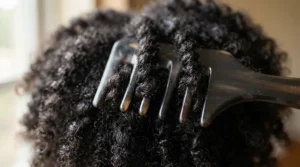
Wide Tooth Afro Comb for Coils vs Other Hair Tools
| Tool | Best For | Risk on 4c Hair | Best For (Summary) |
|---|---|---|---|
| Wide tooth afro comb for coils | Wet or damp detangling, sectioning | Low if used with moisture | Everyday wash-day work |
| Afro pick | Lifting dry hair at the roots | Medium if used on wet knots | Volume and shape |
| Fine-tooth comb | Parting, edges (carefully) | High for full-head detangling | Precision only |
| Paddle or bristle brush | Smoothing stretched hair | Medium-high on tight coils | Blow-dried, stretched hair |
A wide tooth afro comb for coils is the workhorse, and the pick is the finisher. The fine-tooth comb is a specialist to be used sparingly on 4c hair, and it belongs on the edges only when the hair is well lubricated. The takeaway: do not ask any single tool to do all four jobs.
The pick’s cultural weight is worth knowing too. The Fitzwilliam Museum at the University of Cambridge traces the African hair comb across roughly 5,500 years, including its re-emergence among diaspora communities in Britain, and notes how afro combs took on wider political and cultural meaning in the twentieth century.
Coil Pattern: Why It Should Steer Your Comb Choice
Your coil pattern is the single most useful piece of information when shopping. 4c hair is not a uniform crown of identical spirals. Many people have a mix of tighter and looser coils, finer strands at the nape and thicker sections at the crown.
Here is how that plays out in practice:
- Tight, dense coil pattern with visible shrinkage: favour wider spacing and longer teeth, because shorter teeth simply bunch.
- Mixed coil pattern with looser sections: a dual-sided comb like the Tangle Teezer Wide Tooth Comb can handle both.
- Fine but tightly coiled strands: choose smoother, slimmer teeth and lighter strokes, since fine strands are less forgiving.
- Thick, coarse coils: a rigid pick like the Chicago Comb Model 7 or a metal pick will hold its shape.
The lesson is that your coil pattern is not a label to be filed away; it is a shopping specification. Feel your hair at the crown, nape and edges, then decide.
Breakage Prevention: Common Problems and Practical Fixes
Breakage prevention is mostly about habits, not gadgets. The British Association of Dermatologists’ guide to caring for Afro-textured hair points out that not washing when necessary can lead to product build-up, which can irritate the scalp, while washing too frequently can cause dryness. Both extremes matter for how easily a comb moves.
Problem: Hair snaps mid-strand during detangling.
Fix: add more slip, work in smaller sections and start at the ends. Switch to a wider-spaced comb if snapping continues.
Problem: Hair feels rough after combing.
Fix: check the comb’s teeth for seams or burrs. Replace it if the surface is uneven.
Problem: Hair clumps and knots after styling.
Fix: detangle before styling, not after. Trying to comb through a finished twist-out invites damage.
Problem: Static and flyaways with dry hair.
Fix: switch to an anti-static material like carbon fibre, and add a light moisturiser to dry hair.
Problem: Sore scalp after combing.
Fix: choose rounded-tip teeth and avoid pressing hard. If soreness persists, seek professional advice.
Small changes compound. A better comb plus better technique reduces breakage more than any single miracle product.
Protective Styling: Where Your Comb Fits Before, During and After
Protective styling tucks hair away to reduce daily manipulation, but the comb still matters at either end of the style. Prepare badly and you lock tangles in. Take down carelessly and you snap the hair you worked to protect.
Before installing. Detangle fully on damp, moisturised hair using a detangler such as the Denman D28 Wide Tooth Comb or Wet Brush Wet Comb. Hair that goes into braids or twists already knotted stays knotted underneath.
During. Tension is the bigger risk. The BAD leaflet recommends leaving the delicate hairs at the hairline, or “edges”, out of braids to avoid tension there, and says braids should not be left in longer than six weeks. It also cautions that tying braids into tight ponytails or buns increases traction alopecia risk.
After. Take styles down slowly, with plenty of moisture, and detangle from the ends. Then use a pick like the Kare & Kind Hair Pick Comb only once the hair is dry and fully separated.
Why this matters: the British Skin Foundation explains that traction alopecia is mainly due to hair-styling practices and that it is possible tightly curled Afro-textured hair may be more susceptible to breakage. If you notice soreness, bumps or thinning at the hairline, speak to a GP or dermatologist rather than pushing on.
Real-World Scenarios: Which Comb for Which Life?
Scenario 1: The student on a tight budget. You live in shared accommodation, have limited bathroom time and roughly a tenner to spend. The Kare & Kind Hair Pick Comb (4 pcs) covers lifting and gifting, and adding a Wet Brush Wet Comb gives you a shower-friendly detangler. Total spend stays modest, and each tool has a clear job.
Scenario 2: The parent doing Sunday-night prep. You are detangling a child’s 4c hair before school braids and need patience plus speed. The Tangle Teezer Wide Tooth Comb offers a gentler side for the initial pass and a firmer side for stubborn knots, which helps keep sessions short and calm. Keep strokes slow and always start at the ends.
Scenario 3: The frequent stylist or serious enthusiast. You use picks daily on dry hair, want longevity and dislike static. The Chicago Comb Model 7 and the Kare & Kind Metal Hair Pick Comb (2 pcs) give you a rigid, reliable pair, and a wet comb such as the Denman D28 handles the messy stage.
The pattern across all three is the same: match tools to stages of your routine rather than chasing a single hero product.
Long-Term Cost and Maintenance: Making Your Combs Last
Combs are cheap, but replacing damaged ones every month adds up, and worn teeth cause damage. Good maintenance keeps them smooth and hygienic.
- Remove hair after every use. Trapped hair and product build-up make combing less smooth.
- Wash regularly. Tangle Teezer suggests removing hair after each use, rinsing with warm water and using mild soap or shampoo if product builds up, then air drying. That advice suits most plastic combs.
- Skip heat. The brand warns that teeth can melt, so do not use its comb with heat.
- Inspect the teeth. If you spot a chip, burr or seam, retire the comb. One damaged tooth can snag hundreds of strands.
| Price Tier | Products | What You Get | Trade-Off |
|---|---|---|---|
| Under £10 | Denman D28 Wide Tooth Comb, Kare & Kind Hair Pick Comb (4 pcs), Kare & Kind Metal Hair Pick Comb (2 pcs), HuaJiao 6 Pcs Afro Comb | Low-risk, replaceable tools | Variable finish on multipacks |
| Under £12 | Tangle Teezer Wide Tooth Comb, Wet Brush Wet Comb | Brand-designed detanglers | Slightly higher cost per tool |
| £12-£20 | Chicago Comb Model 7 | Rigid, durable, anti-static | Highest upfront spend |
The value story is straightforward. Cheaper multipacks win on cost per tool, while the Chicago Comb Model 7 wins on cost per year if it lasts. Choose based on how often you use a pick and how much you hate replacing things.
Common Mistakes When Buying an Afro Comb for 4c Hair
Mistake one: buying a set of ten and assuming variety equals quality. Big multipacks can be brilliant for spares, but check the finish on each tooth.
Mistake two: using a pick on wet knots. Picks lift, they do not detangle. A wet, matted section needs a proper detangling comb and plenty of slip.
Mistake three: ignoring tooth ends. Beautiful colour and a clever handle mean nothing if tines are rough.
Mistake four: trusting the phrase “suitable for all hair types”. Listings for all hair types rarely address 4c specifically, so look for wide spacing and long teeth.
Mistake five: never replacing a worn comb. Chipped teeth hurt hair over time.

FAQ
❓ Can I use an afro comb on wet 4c hair?
❓ Is plastic, metal or carbon fibre best for a 4c afro pick?
❓ How often should I clean my afro comb?
❓ Is a wide tooth comb better than a detangling brush for 4c hair?
❓ Will using a pick ruin my twist-out?
Conclusion
Finding the right afro comb for 4c hair comes down to matching tool to task. Detanglers like the Tangle Teezer Wide Tooth Comb, Denman D28 Wide Tooth Comb and Wet Brush Wet Comb belong on wet, moisturised hair. Picks like the Chicago Comb Model 7, the Kare & Kind Hair Pick Comb (4 pcs), the Kare & Kind Metal Hair Pick Comb (2 pcs) and the HuaJiao 6 Pcs Afro Comb belong on dry hair when you want lift and shape.
Remember the essentials: a detangling comb for 4c coily hair needs wide, smooth teeth and plenty of slip, while a gentle afro comb for tight curls is defined by low tension rather than softness. Let your coil pattern guide your choice, make breakage prevention a habit rather than a gadget, and treat protective styling as a partnership between good tools and low tension.
Lastly, be honest with yourself about what hurts. Persistent soreness, thinning at the hairline or scalp irritation deserves professional advice rather than another product. A wide tooth afro comb for coils is a wonderful ally, but it is not a cure.
Recommended for You
- Metal Tail Comb: 7 Best Picks for UK Stylists & Home Use (2026)
- Comb For Wig Application: 7 Best Picks For Flawless Edges (2026)
- Wide Tooth Comb vs Detangling Brush: 7 Best UK Picks (2026)
Disclaimer: This article contains affiliate links. As an Amazon Associate, I earn from qualifying purchases. If you purchase products through these links, we may earn a small commission at no additional cost to you.
✨ Found this helpful? Share it with your friends! 💬🤗
