
In This Article
Here’s a scenario every frequent flyer knows too well: you land in Bangkok, plug in your trusty straightener from home, and thirty seconds later there’s a pop, a puff of smoke, and a very expensive paperweight sitting on the hotel bathroom counter. The best travel straighteners solve this exact problem — they’re compact, dual voltage hair styling tools built specifically to run safely on both the 110-120V supply you’ll find in North America and the 220-240V supply used across the UK, Europe, Asia and beyond, without needing a bulky converter. That’s the 40-second version. The longer version is a lot more interesting, and a lot more useful if you don’t want to fry your hair (or your straightener) on your next trip.
We’ve spent time digging through real product specifications, genuine aggregated customer feedback and independent safety guidance to build this guide, because most “best of” lists in this niche are just repackaged Amazon listings with a fresh coat of paint. This one isn’t. We’ve pulled together seven genuinely different straighteners — spanning ultra-cheap mini irons to premium cordless options — so whether you’re after a compact flat iron abroad for a long-haul backpacking trip or a proper universal voltage straightener for monthly business travel, there’s something here that fits your suitcase and your budget.
Before we get into the products themselves, it’s worth understanding what actually makes a straightener “travel safe,” because the answer isn’t as simple as most packaging suggests. Voltage compatibility, wattage draw, plug adaptor requirements and even airline battery rules all play a part, and we’ll cover every one of them.
Quick Comparison Table: Best Travel Straighteners at a Glance
| Product | Voltage Range | Best For | Price Range |
|---|---|---|---|
| ghd Unplugged | Universal (cordless, USB-C) | Frequent flyers wanting cordless freedom | £180-£200 range |
| T3 SinglePass Compact | Auto 100-240V | Carry-on-only travellers | £70-£90 range |
| Lily England 2-in-1 | Dual voltage 100-230°C | Two-in-one styling on a budget | Under £40 |
| Remington S1370 Slim | Worldwide voltage | Full-size performance, small price | Under £25 |
| BaByliss GPB004E Mini | Automatic voltage adjustment | Ultra-compact carry-on packing | Under £20 |
| Wavytalk Mini | Dual voltage | Bangs, fringes and short hair touch-ups | Under £15 |
| CHI Tourmaline Mini | Dual voltage | Salon-grade plates in a small footprint | £50-£70 range |
Looking at the spread above, it’s clear there’s no single “best” answer — it depends entirely on how you pack and how often you fly. The ghd Unplugged justifies its premium price tag for people who genuinely can’t find a plug socket (think festivals, long-haul layovers, campervans), while the BaByliss GPB004E Mini and Wavytalk Mini prove that dual voltage travel straighteners don’t have to cost a fortune if all you need is a quick touch-up tool. The T3 SinglePass Compact and CHI Tourmaline Mini sit in the sensible middle ground most travellers will actually want.
💬 Found a favourite already? Scroll down to see exactly why it made the cut — the detail matters more than the price tag here.
Top 7 Best Travel Straighteners: Expert Analysis
1. ghd Unplugged Cordless Hair Straightener — best cordless straightener for universal voltage travel
The standout here is that there’s no cord and no plug socket dependency at all once it’s charged, which changes the travel-straightener conversation entirely. Under the hood sits ghd’s hybrid co-lithium technology, combining dual-zone ceramic heaters with a lithium battery pack that holds a consistent 185°C for up to 20 minutes of continuous styling — enough for most hair lengths in one sitting. Because it charges via USB-C rather than plugging into the mains, universal voltage becomes a non-issue; you’re charging from a power bank, laptop, or any USB-C wall adaptor, sidestepping the whole voltage conversation altogether. Based on the spec comparison with corded travel irons, this is the only model here that removes voltage risk completely rather than just managing it, which is worth the premium if you regularly stay in properties with unreliable sockets. Reviewers consistently highlight the 45-second heat-up and the reassurance of the five-bar battery indicator, though a recurring theme in feedback is that the 20-minute runtime is tight for very long or thick hair, meaning a mid-styling recharge pause is sometimes needed.
Pros:
- ✅ No mains dependency — charges via USB-C anywhere
- ✅ Consistent 185°C prevents accidental overheating
- ✅ Genuinely cabin-luggage friendly and TSA-considerate design
Cons:
- ❌ 20-minute battery life can be tight for thick, long hair
- ❌ Cannot be used while charging
Priced around £190, this sits at the premium end, but for travellers who genuinely can’t rely on foreign sockets, it’s a defensible investment rather than a luxury.

2. T3 SinglePass Compact Travel Flat Iron — best auto-world-voltage compact styler
What makes this one click for frequent travellers is the microchip-controlled auto world voltage system, which reads the incoming supply and adjusts automatically between 100V and 240V without you touching a switch. The 0.8-inch custom-blend ceramic plates run at a fixed 410°F (210°C), a temperature T3 has tuned specifically to avoid the hot-spot damage you get from cheaper irons that cycle unevenly. What most buyers overlook about this model is the heat-resistant travel cap — it means you can pack it away seconds after use rather than waiting for it to cool on a hotel counter, which matters when you’re checking out in a hurry. Reviewers frequently note that the single fixed temperature is actually a feature rather than a limitation for most hair types, though a common complaint is that finer or already-damaged hair may find 410°F slightly aggressive without a heat protectant.
Pros:
- ✅ Genuine auto-sensing 100-240V worldwide compatibility
- ✅ Even heat distribution reduces snagging and hot spots
- ✅ Compact size with a proper heat-resistant travel cap
Cons:
- ❌ Single fixed temperature offers no flexibility for fine hair
- ❌ Smaller plates mean longer styling time on thick hair
In the £70-£90 range, this is the pick we’d suggest to anyone who travels several times a year and wants a genuine “forget about it” voltage solution without ghd-level spending.
3. Lily England 2-in-1 Ceramic Flat Iron & Curler — best value dual-voltage 2-in-1
The clever bit here is that one tool replaces two — the rounded barrel design lets you switch between poker-straight results and loose curls without packing a separate curling wand, which is a genuine space-saver in carry-on luggage. The adjustable 100-230°C range with digital display means you’re not stuck with a single aggressive setting, and the dual voltage technology is confirmed by Amazon buyers using it across Europe without issue. On paper this means fine or colour-treated hair can run cooler while thicker hair gets the full heat, a flexibility that budget dual-voltage travel straighteners often skip entirely to hit a lower price point. Aggregated review sentiment is genuinely mixed but instructive: many customers report results comparable to premium brands at a fraction of the cost, while a smaller but consistent group flags that the plates run hot enough to be risky on very fine or already-damaged hair without careful temperature management.
Pros:
- ✅ Straightens and curls with one device, saving luggage space
- ✅ Adjustable 100-230°C suits multiple hair types
- ✅ Digital temperature display removes guesswork
Cons:
- ❌ Button placement can accidentally shift temperature mid-use
- ❌ Not ideal for very fine or heat-damaged hair at top settings
At under £40, this is arguably the best straightener for travelling abroad if you want two styling tools condensed into one for a genuinely modest outlay.
4. Remington S1370 Slim Straight 215 — best budget full-size worldwide voltage iron
This one earns its spot by proving that “worldwide voltage” doesn’t have to mean “miniature.” The 110mm floating ceramic plates are a proper working size — noticeably larger than most travel-specific irons — while still carrying genuine worldwide voltage certification for international use. A 30-second heat-up to 215°C and a hinge that locks the plates together for compact storage mean it behaves like a travel tool despite the full-size footprint. Here’s what the spec sheet won’t spell out clearly: floating plates apply more even pressure across the hair shaft than fixed plates, which reduces the pulling and snagging that makes styling take longer, particularly noticeable on mixed-texture hair. Reviewers commonly cite this as a reliable “does exactly what it says” iron rather than an exciting one, with the auto shut-off feature repeatedly mentioned as reassuring for hotel-room use.
Pros:
- ✅ Full-size 110mm plates despite genuine worldwide voltage
- ✅ Fast 30-second heat-up saves time before flights
- ✅ Auto shut-off adds peace of mind in hotel rooms
Cons:
- ❌ Larger footprint than dedicated mini travel irons
- ❌ Only one fixed heat setting at 215°C
Under £25, this is the straightener we’d point budget-conscious travellers towards if they refuse to compromise on plate size for the sake of packing small.
5. BaByliss GPB004E Mini Liss & Go Travel Straightener — best ultra-compact automatic-voltage mini
At just 15cm long, this is genuinely pocket-sized, and the automatic voltage adjustment means there’s no manual switch to forget mid-trip — plug in an adaptor and it simply works. The narrow 14mm x 60mm plates are purpose-built for short to medium hair rather than full-length styling sessions, a trade-off BaByliss makes deliberately to hit this size. Buyers using it across Turkey and France with a standard plug adaptor confirm the automatic switching genuinely works exactly as advertised, without needing to flip a manual voltage toggle before use. What most buyers overlook is that this narrow-plate design actually makes it more precise for fringes, flyaways and root touch-ups than wider full-size irons, even though it wasn’t marketed on that angle. The trade-off, as expected from real user reports, is that longer or thicker hair takes considerably more passes and more patience than a full-size tool would.
Pros:
- ✅ Genuinely automatic voltage switching — no manual toggle needed
- ✅ 15cm size fits in the smallest toiletry bag or handbag pocket
- ✅ Confirmed by real travellers to work across multiple countries
Cons:
- ❌ Narrow plates make full-length styling slow on longer hair
- ❌ Not suited to thick or coarse hair as a primary iron
Priced under £20, this is best treated as a dedicated fringe-and-touch-up tool for travel rather than a primary straightener replacement.
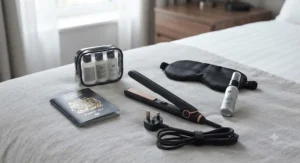
6. Wavytalk Mini Hair Straightener — best cheap dual voltage mini for bangs and short hair
The appeal is straightforward: a genuinely dual-voltage mini iron at one of the lowest price points in this entire list, aimed squarely at people who just need something small, cheap and reliable for occasional touch-ups abroad. The 0.7-inch ceramic plates heat quickly and are explicitly marketed and sold as dual voltage for travel, making it a common budget recommendation across independent buying guides covering this category. Here’s the honest trade-off: at this price point, you’re not getting the plate technology, even heating, or temperature precision of the pricier options on this list, and reviewers treat it accordingly — as a backup or secondary tool rather than an everyday styler. Where it consistently earns praise in aggregated feedback is portability and value for occasional flyers who don’t want to risk a £150 iron getting lost or damaged in transit. Reviewers commonly pair it with a heat protectant spray given the more basic ceramic coating compared to titanium or tourmaline alternatives.
Pros:
- ✅ Genuinely dual voltage at an entry-level price point
- ✅ Compact 0.7-inch plates ideal for bangs and short styles
- ✅ Low financial risk if lost, damaged or confiscated abroad
Cons:
- ❌ Basic ceramic coating heats less evenly than premium plates
- ❌ Not built for daily full-head styling long term
At under £15, this is the sensible pick for occasional travellers who want dual voltage cover without spending real money on a tool that mostly sits in a drawer.
7. CHI Tourmaline Ceramic Mini Flat Iron — best mini with salon-grade tourmaline plates
CHI has built genuine salon credibility over decades, and this mini iron carries that reputation down into a proper travel size without cutting the plate technology corners cheaper minis often do. The 0.75-inch tourmaline-infused ceramic plates release negative ions as they heat, which in practice means less static and frizz than standard ceramic alone — a detail that matters far more in humid destinations than most packing lists acknowledge. Genuine dual voltage support means it travels confidently between UK, European and North American sockets with a simple plug adaptor. Based on the spec comparison with the other mini irons here, the tourmaline coating is the meaningful upgrade: it glides with less drag, which reduces the repeated passes that cause heat damage over a trip. Aggregated customer sentiment consistently favours CHI on longevity and finish quality, with the recurring caveat that the smaller 0.75-inch plate size means longer hair still takes noticeably more time to style than a full-size iron would.
Pros:
- ✅ Tourmaline ceramic plates reduce frizz and static in humid climates
- ✅ Trusted, decades-old professional brand reputation
- ✅ Confirmed dual voltage for genuine worldwide use
Cons:
- ❌ Smaller plate size extends styling time on longer hair
- ❌ Sits at a higher price point than basic mini irons
In the £50-£70 range, this is the mini iron we’d recommend to anyone who wants genuinely professional-grade results without packing a full-size styler.
Practical Usage Guide: Getting the Most From Your Travel Hair Tools Dual Voltage
Buying the right travel hair tools dual voltage setup is only half the job — using them correctly abroad is where most people actually run into trouble. First, always check the small print on the barrel or handle before you plug anything in, because “dual voltage” and “100-240V” printed there is the only reliable confirmation; marketing copy on a box is not a substitute for checking the appliance itself. Second, invest in a proper plug adaptor rather than a cheap multi-region one from a pound shop, since a loose-fitting adaptor can cause intermittent power or, worse, overheating at the connection point.
During the first 30 days of ownership, resist the temptation to run any new straightener at maximum heat immediately — most ceramic and titanium plates benefit from a couple of sessions at a lower setting to “bed in,” and this is also when you’ll notice if a unit has an inconsistent hot spot worth returning it for. A common mistake is packing the straightener while still warm; always allow at least two minutes of cooling with the plates open before closing a travel case, since trapped heat can degrade both the coating and any protective pouch lining over repeated trips. For maintenance, wipe plates with a barely damp cloth after each use once cooled — buildup from styling products is the single biggest cause of reduced glide and uneven heating over time, far more than the plates themselves wearing out.
Finally, if you’re travelling somewhere with notably unstable electricity supply, a portable surge-protected adaptor adds a genuinely useful layer of protection that a standard plug adaptor doesn’t provide.
Real-World Scenarios: Compact Flat Iron Abroad for Every Type of Traveller
Picture three very different trips. First, the long-haul backpacker spending three months moving between hostels across Southeast Asia with a single 40-litre pack — for this person, a compact flat iron abroad genuinely needs to be small, cheap enough to lose without heartbreak, and dual voltage without a manual switch to fiddle with in a dim hostel bathroom. The Wavytalk Mini or BaByliss GPB004E Mini fit this brief precisely, prioritising size and low financial risk over polish.
Second, the monthly business traveller who needs to look presentable stepping off a red-eye into back-to-back meetings, with reliable hotel power but zero patience for slow styling. Here, the T3 SinglePass Compact or CHI Tourmaline Mini make more sense, trading a little extra spend for consistent, fast, even results that hold up under time pressure.
Third, the once-a-year holidaymaker heading to a villa or campsite where socket access is genuinely unpredictable — think rural Greece or a European campervan trip. This is precisely the scenario the ghd Unplugged was built for, since a cordless charge means the state of the local wiring simply stops mattering. Matching the tool to the trip, rather than defaulting to whatever’s cheapest or most premium, is the single biggest factor in travel-styling satisfaction.
How to Choose the Best Travel Straighteners
Choosing the right iron comes down to working through a handful of criteria in order, rather than being swayed by a single flashy spec:
- Confirm genuine dual or auto voltage — look for “100-240V” printed on the appliance itself, not just marketing text on the packaging.
- Match plate size to your hair length — mini plates under 1 inch suit short hair and fringes; anything past shoulder length benefits from at least 1-inch plates.
- Check the heat range fits your hair type — fine or colour-treated hair needs adjustable lower settings, while thick or coarse hair wants a reliable 200°C-plus ceiling.
- Weigh cordless versus corded — cordless models solve unreliable sockets but limit continuous run time; corded models rely on power but rarely run out mid-style.
- Factor in packed size and weight — a heat-resistant pouch or cap is a genuine convenience, not a gimmick, when packing while still slightly warm.
- Read aggregated reviews for your specific hair type, since a straightener that performs brilliantly on fine hair may disappoint on thick, curly hair, and vice versa.
- Set a realistic budget band based on frequency of travel — occasional flyers rarely need to spend premium money on a tool that mostly sits unused at home.
Working through these in sequence, rather than starting with price alone, consistently produces a better match than shopping by brand recognition first.
✨ Ready to compare a shortlist side by side? Scroll back up to the comparison table and narrow it down in seconds.
Dual Voltage Travel Straighteners vs Standard Straighteners
The core difference between dual voltage travel straighteners and standard domestic models isn’t cosmetic — it’s the internal transformer. Standard UK straighteners are typically wired for a fixed 220-240V supply, meaning the internal components are calibrated for that specific range and simply cannot handle 110-120V safely without a separate converter. Dual voltage models include either an automatic sensing transformer or a manual switch that allows the same internal heating element to operate correctly across both ranges, which is precisely why they’re rated for international use in the first place.
| Feature | Standard Straightener | Dual Voltage Travel Straightener |
|---|---|---|
| Voltage range | Fixed 220-240V (UK/EU) | 100-240V or auto-sensing |
| Safe for US/Canada use | No, without a converter | Yes, with a plug adaptor only |
| Typical plate size | Full-size, 1 inch+ | Often mini, 0.5-1 inch |
| Best for | Home use only | Frequent or international travel |
As the table shows, the trade-off for true international compatibility is often a smaller plate size, since compact dual-voltage transformers are easier to fit into a slimmer housing. Standard straighteners still win on raw styling speed for everyday home use, but they become genuinely risky — even fire-risk territory in extreme cases — the moment they’re plugged into an incompatible foreign socket without a proper voltage converter.
Universal Voltage Straighteners: Common Mistakes When Buying
The single biggest mistake buyers make is assuming a plug adaptor alone makes any straightener travel-safe. A plug adaptor changes the physical shape of the plug so it fits a foreign socket; it does nothing whatsoever to change the voltage running through it, and travel adaptor guidance from Electrical Safety First is explicit that dual-voltage-rated appliances are the only way to avoid needing a separate transformer altogether.
A second common error is trusting packaging claims over the appliance’s own printed rating — always check the barrel, handle or plug itself for “100-240V,” since marketing copy occasionally overstates compatibility. Third, buyers frequently overlook wattage; a genuinely universal voltage straightener drawing higher wattage may still trip older hotel circuits in countries with less robust wiring, even if the voltage itself is technically compatible. Finally, many people buy the cheapest mini iron available assuming “dual voltage” is a binary yes/no feature, when in practice build quality, plate coating and even heat distribution vary enormously between models at the same nominal voltage spec — which is exactly why the products above sit at such different price points despite sharing the same core compatibility claim.
Best Straighteners for Travelling Abroad: A Regional Voltage & Plug Guide
Different regions genuinely do require different preparation, and lumping “abroad” into one category is where a lot of packing mistakes happen. The UK and most of Europe run on 220-240V with Type G (UK) or Type C/F (EU) plugs, meaning UK-bought straighteners already work at native voltage across the continent — only the plug shape needs adapting. North America runs at 110-120V, which is where genuine dual voltage becomes essential rather than optional, since a UK-only straightener will be seriously damaged or become a fire risk on that supply without a proper transformer.
Southeast Asia and Australia typically sit at 220-240V like the UK, but socket shapes vary significantly by country, so a universal adaptor rather than a single-country one is the safer buy for multi-stop trips. According to Wikipedia’s overview of mains electricity standards by country, voltage tolerances and plug types genuinely do vary enough between neighbouring countries that assuming regional consistency is a real risk, particularly across parts of South America and the Caribbean where both 110V and 220V systems coexist depending on the specific country. Building your straightener choice around your actual itinerary — rather than a generic “works everywhere” assumption — remains the single most reliable approach.
Travel Straighteners That Work in USA From the UK: Safety, Regulations & Compliance
If you’re heading from the UK to the USA, the voltage jump from 230V down to 120V is the part that catches people out, since a straightener rated only for UK voltage will draw dangerously excessive current on the lower US supply, risking overheating or component failure. Every product featured in this guide is either genuinely dual voltage or auto-sensing specifically to cover this exact UK-to-USA and USA-to-UK scenario without a separate converter.
Airline rules add a second layer worth understanding before you pack. According to the UK Civil Aviation Authority’s guidance on packing electrical items, devices containing lithium batteries — which includes cordless straighteners like the ghd Unplugged — must be carried in hand luggage rather than checked baggage, specifically so any overheating issue can be dealt with quickly in the cabin. Corded straighteners without batteries, such as the Remington S1370 Slim or CHI Tourmaline Mini, don’t carry the same restriction and can go in either hand or hold luggage, though packing them in carry-on avoids any risk of damage in transit regardless. Always allow plates to cool fully and use the included pouch or cap before packing, since a small minority of airport security checks have flagged loose heating elements for closer inspection.
Long-Term Cost & Maintenance: Is a Worldwide Compatible Straightener Worth It?
Looking purely at upfront price, a £15 mini iron looks like the obvious economical choice next to a £190 cordless model. But total cost of ownership tells a slightly different story once you factor in replacement frequency. Budget minis with basic ceramic coatings typically need replacing within one to two years of regular travel use as plates lose their even-heat performance, while tourmaline or titanium-plated models in the mid-range tend to hold performance for three to five years of similar use.
| Product Tier | Typical Lifespan | Cost-Per-Year Estimate |
|---|---|---|
| Budget mini (e.g. Wavytalk Mini) | 1-2 years | Lower upfront, higher long-term replacement cost |
| Mid-range (e.g. CHI Tourmaline Mini) | 3-5 years | Balanced value over time |
| Premium (e.g. ghd Unplugged) | 5+ years, often with warranty | Higher upfront, lowest cost-per-use long term |
The practical takeaway from this comparison is that occasional travellers — one or two trips a year — genuinely do come out ahead financially sticking with a budget mini and simply replacing it if it fails, since the premium models take several years of use to justify their higher upfront cost. Frequent flyers, on the other hand, tend to reach better value from a mid-range or premium option precisely because the cost-per-use drops sharply the more often the tool actually gets packed and used.
✨ Don’t Miss These Exclusive Deals!
🔍 Take your travel styling routine to the next level with these carefully selected picks. Click on any highlighted product to check current pricing and availability before your next trip — these tools will help you pack lighter and style smarter wherever you land. ✈️🔋
FAQ: Best Travel Straighteners
❓ Do all hair straighteners work abroad?
❓ What's the difference between a travel adaptor and a voltage converter?
❓ Can I take a cordless straightener in hand luggage?
❓ Are mini travel straighteners as good as full-size ones?
❓ How do I know if my straightener is genuinely dual voltage?
Conclusion
Choosing among the best travel straighteners really comes down to being honest about how you actually travel, rather than chasing the most expensive or most hyped option on the shelf. Occasional holidaymakers are genuinely well served by an inexpensive, confirmed dual-voltage mini like the Wavytalk Mini or BaByliss GPB004E Mini, while frequent flyers and business travellers tend to get better long-term value from mid-range picks like the T3 SinglePass Compact or CHI Tourmaline Mini. For anyone regularly facing unpredictable power access — campsites, older properties, remote stays — the ghd Unplugged‘s cordless design removes the voltage question entirely, at a price that reflects that convenience.
Whichever you choose, the two non-negotiables remain the same: confirm genuine dual voltage on the appliance itself, and pack a proper plug adaptor rather than relying on packaging claims alone. Get those two details right, and the rest is simply a question of matching plate size and heat range to your own hair.
✨ Found Your Perfect Travel Straightener?
🔍 Check current pricing on today’s top pick before you pack — availability and prices can shift quickly, so it’s worth a quick look ahead of your next trip. 🧳💁♀️
Recommended for You
- 7 Best Mini Hair Straighteners UK 2026: Small But Mighty Picks
- 7 Best Wide Plate Straighteners 2026: Tame Thick Hair Fast
- Titanium Hair Straighteners: 7 Best Picks Tested for 2026
Disclaimer: This article contains affiliate links. As an Amazon Associate, I earn from qualifying purchases. If you purchase products through these links, we may earn a small commission at no additional cost to you.
✨ Found this helpful? Share it with your friends! 💬🤗
