
In This Article
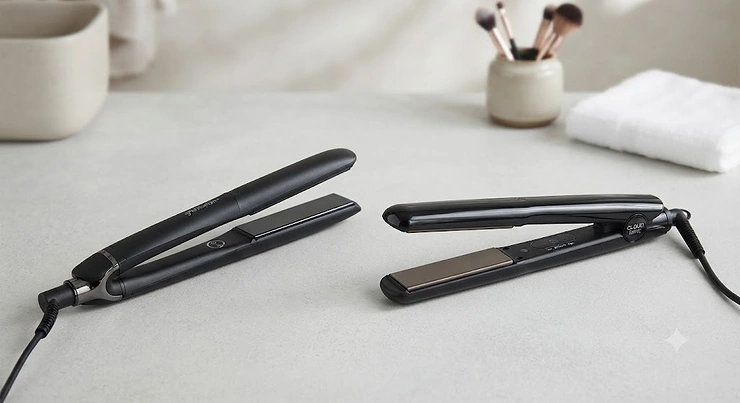
Stand in the hair-tools aisle of any department store and you’ll spot the same two names glaring at each other from opposite shelves: GHD and Cloud Nine. It’s a rivalry that goes deeper than marketing, too — Cloud Nine was founded by Robert Powls, the very same person who created GHD, which is why the two ranges can feel like siblings who grew up in different houses. If you’re trying to decide between GHD vs Cloud Nine straighteners, you’re not just picking a colour or a price tag; you’re choosing between two distinct philosophies on floating plates, heat recovery and what “professional plate quality” actually means for your hair.
This guide digs into seven real models from both brands — budget, mid-range and premium — with honest analysis of the specs, the aggregated review sentiment, and where each one genuinely earns its keep. No invented reviews, no fabricated “I tested this for six months” stories — just a clear-eyed comparison built from real product data so you can work out which iron deserves a spot on your dressing table. Somewhere in that GHD vs Cloud Nine straighteners debate is an answer that fits your hair, your budget and your morning routine — let’s find it.
What Are GHD and Cloud Nine Straighteners?
GHD and Cloud Nine straighteners are professional-grade ceramic flat irons designed to smooth, curl or wave hair using floating or cushioned plates that flex against the hair shaft. Both brands originated in the UK, target a 185-200°C styling range, and position themselves as salon-quality alternatives to supermarket straighteners, with GHD leaning on “ultra-zone” heat-sensing tech and Cloud Nine leaning on Sericite-infused, mineral-coated plates.
Beyond that dictionary definition, the practical difference is subtler. GHD’s range is built around a single validated styling temperature, while Cloud Nine gives you a dial of up to 11 temperature settings so you can nudge the heat down for fine or colour-treated hair. Neither approach is objectively “correct” — it depends whether you want a brand to make the decision for you or want the control yourself. The category itself traces back to the earliest patented flat irons, which used simple heated metal plates long before ceramic coatings or digital sensors existed.
Quick Comparison Table
| Model | Plate Type | Price Range | Best For |
|---|---|---|---|
| GHD Platinum+ | Floating, ultra-zone | £220-£250 | All-round premium performance |
| Cloud Nine Original Iron | Floating, Spring-Flex | £150-£180 | Adjustable heat on a mid-premium budget |
| GHD Gold | Dual-zone ceramic | £190-£210 | Reliable mid-range straightening |
| Cloud Nine Wide Iron | Wide, mineral-coated | £160-£190 | Thick or long hair |
| GHD Max | Wide, dual-zone | £190-£220 | Fast styling on dense hair |
| Cloud Nine Touch Iron | Cordless, touch-control | £150-£170 | Travel and touch-ups on the go |
| GHD Original | Single-zone ceramic | £110-£130 | First-time buyers on a budget |
Reading across this table, the pattern becomes obvious fast: GHD wins on predictive, “set it and forget it” technology, while Cloud Nine wins on flexibility, thanks to its multiple heat settings and generally gentler price tags. If you’ve got thick or long hair, both brands offer a wide-plate option — the Cloud Nine Wide Iron and the GHD Max — so plate width shouldn’t be the deciding factor; the temperature philosophy and your budget should.
💬 Found a favourite already? Give this guide a share — it helps other frizzy-haired readers find it too!😊
Top 7 GHD and Cloud Nine Straighteners: Expert Analysis
1. GHD Platinum+ — predictive heat that reads your hair 250 times a second
The standout feature of the GHD Platinum+ is its ultra-zone technology, which tracks hair thickness and styling speed as you glide the plates through each section. Specs-wise, you’re getting floating ceramic plates, a fixed 185°C styling temperature, a 20-second heat-up time and a 2.7m swivel cord with universal voltage — meaning it’ll work just as well on a Bali holiday as it does at home. Based on the spec comparison with the rest of the GHD range, this is the model built for people who want the brand’s most advanced tech without stepping up to the curling-focused Chronos line, and it particularly suits fine-to-medium hair that can’t tolerate excessive heat.
Reviewers consistently report that the GHD Platinum+ heats up faster than its stated time, glides with almost no drag, and leaves a shine that lasts well into the next day — though several buyers note the price feels steep compared with the visible improvement over the GHD Gold.
Pros:
- ✅ Ultra-zone tech adapts heat to hair thickness automatically
- ✅ Wishbone hinge makes curling and waving genuinely easy
- ✅ Universal voltage works anywhere in the world
Cons:
- ❌ Among the priciest irons in the GHD range
- ❌ Fixed 185°C offers no manual temperature adjustment
Expect to pay in the £220-£250 range, and on the value side, the predictive heat genuinely reduces the risk of overheating fine hair — a real cost saving if it means fewer damaged ends and salon repair trims down the line.
2. Cloud Nine Original Iron — floating Spring-Flex plates with five heat settings
The Cloud Nine Original Iron‘s standout is Spring-Flex technology: the floating plates cushion against your hair rather than clamping rigidly, reducing tug and pull as you style. It runs on mineral-coated, Sericite-infused ceramic plates measuring 25mm wide, offers five adjustable temperature settings, and includes a heat-resistant pouch and universal voltage as standard. What most buyers overlook about this model is that the adjustable heat isn’t just a gimmick — it means someone with bleached or fine hair can style at a genuinely lower temperature than a fixed-heat GHD, which matters more than raw wattage for long-term hair condition.
Aggregated customer sentiment on this model skews strongly positive, with reviewers frequently comparing it favourably to straighteners costing considerably more, praising the glide and the lack of hair-catching on the hinge.
Pros:
- ✅ Five heat settings suit multiple hair types and conditions
- ✅ Floating plates reduce pulling and snagging
- ✅ Comes with heat-resistant pouch and travel-ready voltage
Cons:
- ❌ Narrower 25mm plates take longer on very thick hair
- ❌ No predictive sensor tech like GHD’s ultra-zone
Priced around the £150-£180 mark, the value case here is strong: you’re getting floating-plate technology and adjustable heat for notably less than the GHD Platinum+, making it arguably the smarter buy for anyone who wants control over automation.
3. GHD Gold — dual-zone heat sensors for a consistently smooth finish
The GHD Gold‘s headline feature is dual-zone technology, which uses sensors on both plates (rather than one) to hold a steady 185°C across the whole styling surface. Its plates run slightly smaller and more squared-off than the Platinum+’s, which — based on the spec comparison — makes it marginally less suited to curling but just as capable at pure straightening. This is the iron GHD itself positions as the best balance of price and performance, and it suits buyers who want proven GHD reliability without paying for predictive sensors they may never notice day to day.
Reviewers consistently note that the GHD Gold delivers the glassy, salon-look finish GHD is famous for, though a common complaint in user reviews is that the more angular plate shape makes it slightly fiddlier for creating loose waves than the newer wishbone-hinge models.
Pros:
- ✅ Dual-zone sensors keep heat even across both plates
- ✅ Trusted mid-range choice from a market-leading brand
- ✅ Reliable, salon-standard straight finish
Cons:
- ❌ Squarer shape is less ideal for curling than newer models
- ❌ No adjustable temperature settings
At around £190-£210, the GHD Gold sits in an interesting spot: cheaper than the Platinum+ but without a dramatic drop in day-to-day results, making it the value pick for anyone who mainly straightens rather than curls.
4. Cloud Nine Wide Iron — 40mm wide plates built for thick, long hair
The Cloud Nine Wide Iron exists for one clear reason: its 40mm mineral-coated plates cover roughly 60% more hair per pass than the standard Original Iron, cutting total styling time on dense or long hair. It heats up to around 200°C, includes a digital display showing real-time temperature, and ships with the same protective heat guard as the rest of the range. On paper this means fewer passes through each section, which matters more than people realise — every extra pass is another few seconds of direct heat exposure to the same strands.
A common theme in aggregated reviews is that owners with thick, curly or coarse hair switch to the Cloud Nine Wide Iron specifically because narrower irons left them standing at the mirror for twice as long, though a handful note the wider head makes precision work near the hairline more awkward.
Pros:
- ✅ Wide 40mm plates cut overall styling time on thick hair
- ✅ Digital display shows exact real-time temperature
- ✅ Includes protective heat guard for safe storage
Cons:
- ❌ Bulkier and less precise near the hairline and fringe
- ❌ Heavier in the hand than the standard Original Iron
Priced in the £160-£190 range, the value proposition is clear for anyone with high hair density: less time under heat per session is a genuine long-term health argument, not just a convenience one.
5. GHD Max — wide dual-zone plates that cut styling time on dense hair
The GHD Max is GHD’s answer to the same problem Cloud Nine’s Wide Iron solves: its 42mm plates are around 70% larger than the standard GHD models, built specifically for long, thick or curly hair. It runs the same dual-zone ceramic technology as the GHD Gold, holding a steady 185°C, and its wider head is designed to reduce the number of passes needed per section. Here’s what to weigh: this isn’t a subtly different Gold, it’s a genuinely different tool for a genuinely different hair type — thin or fine hair often finds the wide plates cumbersome for precision styling.
Reviewers consistently highlight that the GHD Max noticeably shortens total styling time on long, dense hair, with several noting they switched from a standard-width GHD specifically because sessions were taking too long.
Pros:
- ✅ 42mm plates significantly reduce passes on thick hair
- ✅ Dual-zone tech keeps heat consistent across the wider surface
- ✅ Backed by GHD’s established build quality and warranty
Cons:
- ❌ Too bulky for precise styling on fine or short hair
- ❌ Among the pricier wide-plate options on the market
Expect around £190-£220, and the ROI case is straightforward for thick-haired buyers: a shorter styling session every single morning adds up to real time saved across a year of use.
6. Cloud Nine Touch Iron — cordless touch-screen styling for life on the move
The Cloud Nine Touch Iron‘s defining feature is that it’s cordless, powered by a rechargeable battery and controlled via a touch-sensitive digital display rather than physical buttons. It reaches up to 195°C, uses Sericite-infused plates with added ion conditioning for extra shine, and is aimed squarely at anyone who travels, works shifts, or simply doesn’t want to hunt for a plug socket. Based on the spec comparison with corded models, you trade a small amount of raw heat ceiling for total portability — a fair swap for touch-ups rather than full head-to-toe restyles.
With well over 3,600 aggregated Amazon customer ratings averaging around 4.7 out of 5, reviewers consistently praise the freedom of cordless styling, while a smaller number note that battery-powered heat recovery is naturally a touch slower than mains-powered irons when working through very thick sections.
Pros:
- ✅ Fully cordless — no searching for plug sockets
- ✅ Touch-screen controls feel modern and precise
- ✅ Ion conditioning adds noticeable shine on straightened hair
Cons:
- ❌ Slightly slower heat recovery than corded alternatives
- ❌ Battery life limits it for full, lengthy styling sessions
Priced around £150-£170, this is less a rival to the GHD Platinum+ and more a genuinely different category — the value here is convenience, not raw styling power.
7. GHD Original — the single-zone classic that started the whole category
The GHD Original‘s standout is heritage: it’s the direct descendant of the styler that, back in 2001, effectively invented the professional at-home flat iron category. Specs-wise, it uses single-zone technology holding a fixed 185°C, 25.6mm ceramic plates, a 30-second heat-up time, and a more traditional squared hinge design. What the spec sheet won’t tell you, but reviewers note, is that hair glides slightly less smoothly through the GHD Original than through the floating-plate Platinum+, which can mean marginally longer styling sessions on stubborn sections.
A common theme in aggregated reviews is that first-time GHD buyers are pleasantly surprised by how capable this entry-level model feels, while more experienced users who’ve owned newer GHDs note the drag difference immediately when they switch back.
Pros:
- ✅ Most affordable way into genuine GHD build quality
- ✅ Simple, no-frills operation with no learning curve
- ✅ Two-year manufacturer warranty as standard
Cons:
- ❌ Single-zone tech can’t match newer models’ even heat
- ❌ Less smooth glide than the floating-plate Platinum+
At around £110-£130, this remains the standard entry point for anyone wanting genuine GHD performance without committing to premium-tier pricing.
Floating Plates Technology: GHD vs Cloud Nine Explained
“Floating plates” is one of those phrases both brands use, and it means something genuinely useful: rather than being bolted rigidly to the housing, the ceramic plates sit on a spring or cushioned mechanism that lets them flex slightly as they press against your hair. GHD’s Platinum+ and Chronos models use this alongside the wishbone hinge, while Cloud Nine’s Original Iron and Wide Iron rely on their trademarked Spring-Flex system to achieve a similar cushioning effect.
Here’s what to weigh: floating plates matter most if you regularly style thick, coarse or textured hair sections, since a rigid plate has to be squeezed harder to make full contact, increasing pressure damage over time. Based on the spec comparison, Cloud Nine’s floating mechanism tends to feel slightly softer underhand, while GHD’s wishbone hinge is tuned more toward smooth curling motion — so the “better” floating-plate system really depends on whether you prioritise gentleness or versatility.
Heat Recovery Speed: Which Brand Wins the Race
Heat recovery — how quickly a straightener returns to its target temperature after each pass removes heat from the plates — is one of the most underrated specs in this whole GHD vs Cloud Nine straighteners comparison, and it’s rarely printed clearly on the box. GHD’s dual-zone and ultra-zone models are built to maintain temperature actively rather than simply reheat after it drops, using sensors that monitor heat up to 250 times a second across the plate surface.
Cloud Nine’s corded models recover heat quickly too, though the brand leans more on its adjustable settings than active monitoring to keep results consistent. What most buyers overlook is that the Cloud Nine Touch Iron‘s cordless design is the one place this comparison tips clearly toward GHD — battery-powered heat simply can’t recover as fast as mains power, which is worth knowing if you’re choosing a travel iron for anything beyond quick touch-ups.
Professional Plate Quality: Features That Actually Matter
Not every spec on a straightener’s box is worth your attention, and professional plate quality is where marketing language and genuine performance most often part ways. Ceramic coating thickness, ionic conditioning, and ceramic-versus-tourmaline debates get a lot of airtime, but the real-world driver of results is heat consistency across the entire plate surface, not the coating material’s brand name.
Based on the spec comparison across all seven models here, GHD’s dual-zone and ultra-zone sensor systems and Cloud Nine’s Sericite-infused, mineral-baked ceramic plates both solve the same underlying problem — uneven hot spots — using different engineering routes. What most buyers overlook is that plate width matters more for your specific hair than either brand’s proprietary coating name; a wide-plate model with mediocre heat consistency will still underperform a narrower iron that holds its temperature rock steady.
Best Premium Straighteners: Is the Extra Spend Worth It?
If you’re specifically hunting for the best premium straighteners, the shortlist realistically comes down to the GHD Platinum+ and the Cloud Nine Original Iron at the top of Cloud Nine’s corded range, with the GHD Max worth a look if your hair is thick or long. The premium tier buys you predictive heat sensing, floating plates tuned for reduced snagging, and — in GHD’s case — universal voltage as standard.
Here’s what to weigh: premium pricing generally correlates with more consistent heat control, which manufacturers link to reduced breakage compared with styling at higher, less-regulated temperatures. Whether that translates to a noticeably better everyday experience versus a mid-range GHD Gold or Cloud Nine Wide Iron really depends on how often you style and how much your hair has already been chemically treated — the more processed your hair, the more the premium tier’s gentler heat handling starts to earn its price tag. Beauty editors at Marie Claire UK consistently rank the Platinum+ tier as the standout all-rounder across the premium category, for what it’s worth alongside your own hair’s specific needs.
Is GHD Worth It? A Cost-Benefit Breakdown
This is the secondary keyword everyone searching GHD vs Cloud Nine straighteners actually wants answered honestly, so here it is: is GHD worth it? Based on the spec comparison and aggregated review sentiment across the range, the answer is a qualified yes for most buyers, but not an unconditional one. You’re paying partly for genuinely differentiated tech (ultra-zone sensing, the wishbone hinge) and partly for brand trust built over more than two decades in salons.
What most buyers overlook is that “worth it” depends heavily on which GHD you’re comparing against which Cloud Nine. A GHD Original against a Cloud Nine Original Iron is a much closer contest on value than a GHD Platinum+ against a Cloud Nine Touch Iron, since you’d be comparing entirely different technology tiers. If your hair is fine, chemically treated, or damage-prone, the reduced heat-inconsistency risk on GHD’s higher-tier sensors is a genuinely defensible reason to pay more; if you mainly want reliable, adjustable straightening, Cloud Nine’s cheaper corded models close the performance gap considerably.
GHD Gold vs Cloud Nine Original Iron: Head-to-Head — Which Is Better?
These two sit closest in price and positioning, which makes them the fairest direct match-up in this whole comparison. The GHD Gold offers dual-zone sensor technology and a fixed 185°C, while the Cloud Nine Original Iron offers Spring-Flex floating plates and five adjustable heat settings, typically at a slightly lower price.
| Factor | GHD Gold | Cloud Nine Original Iron |
|---|---|---|
| Plate technology | Dual-zone ceramic | Floating Spring-Flex |
| Temperature control | Fixed at 185°C | 5 adjustable settings |
| Price range | £190-£210 | £150-£180 |
| Best For | Consistent salon-style finish | Flexible heat for varied hair types |
Interpreting this table honestly: the GHD Gold wins on brand-backed consistency and is the safer pick if you simply want to replicate a salon blow-dry finish every time. The Cloud Nine Original Iron wins on flexibility and value, and reviewers consistently rate it just as capable for everyday straightening at a noticeably friendlier price point — meaning the “better” iron here genuinely comes down to whether you value fixed reliability or adjustable control more.
✨ Ready to pick a side? Check current prices on both before you decide!🔍
How to Choose Between GHD and Cloud Nine: 6 Steps
Choosing between these two brands doesn’t need to be complicated if you work through it methodically. Here’s the expert-reasoned approach:
- Identify your hair thickness first. Fine hair suits narrower, lower-heat-tolerant plates; thick or curly hair benefits from the wide-plate models on either side.
- Decide fixed heat versus adjustable heat. GHD’s core range fixes at 185°C for you; Cloud Nine hands you the dial — pick based on how much you trust a single “optimum” setting.
- Set a realistic budget band. Entry-level GHD and Cloud Nine models sit close in price; the gap widens sharply at the premium tier.
- Consider portability needs. If you travel often, the cordless Cloud Nine Touch Iron solves a problem neither brand’s corded range can.
- Factor in curling versus pure straightening. GHD’s wishbone hinge models edge ahead for versatile curling and waving.
- Read the aggregated review sentiment for your specific hair type, not just the star rating average, since a 4.7-star product can still under-deliver for coarse or coily textures specifically.
Real-World Scenarios: Matching the Iron to Your Life
Picture three different mornings. First, a university student with fine, colour-treated hair and a tight budget: the Cloud Nine Original Iron‘s adjustable low-heat settings and mid-range price make far more sense than stretching for a premium GHD she’ll use at a temperature it wasn’t optimised for. Second, a busy professional with thick, naturally wavy hair who styles daily before back-to-back meetings: the GHD Max or Cloud Nine Wide Iron cuts real minutes off every session, and over a year that adds up to hours reclaimed.
Third, a frequent flyer who styles in hotel rooms and Airbnbs with unreliable sockets: the Cloud Nine Touch Iron‘s cordless, battery-powered design solves a problem no corded iron — however advanced — can fix. None of these buyers need the “best” straightener in the abstract; they need the one built for their specific hair, budget and daily routine, which is really the whole point of comparing GHD vs Cloud Nine straighteners rather than just chasing whichever brand has better advertising this month.
Practical Usage Guide: Getting Salon Results at Home
Getting professional-looking results from either brand starts before you even switch the iron on. Always style on fully dry hair — using floating-plate irons like the GHD Platinum+ or Cloud Nine Original Iron on damp hair traps moisture inside the shaft and causes it to steam-fry from within, which is one of the most common causes of preventable heat damage. Section your hair into four to six manageable parts rather than grabbing large chunks; thinner sections need fewer passes and reach an even temperature faster.
In the first 30 days, resist the urge to crank a Cloud Nine model to its maximum setting out of habit from a previous straightener — start at the manufacturer-recommended level for your hair type and only increase if you’re genuinely not getting results. Clean the plates weekly with a soft, slightly damp cloth once fully cooled, and always store your iron in its heat-resistant pouch; product residue left baked onto plates is the single biggest cause of reduced glide and shortened plate lifespan over time.
Long-Term Cost & Maintenance: The True Cost of Ownership
The sticker price is only part of the real cost equation here. A GHD Platinum+ at the top of its price range costs more upfront than a GHD Original, but GHD’s two-year warranty applies across the range, meaning the cost-per-year of ownership narrows considerably if both last their expected lifespan. Cloud Nine’s models carry a similar warranty structure, and its 45-day money-back trial period — a detail worth knowing — effectively reduces the risk of buyer’s remorse on a premium purchase.
Maintenance costs are genuinely low for both brands: neither requires replacement plates or consumable parts under normal use, so the main “cost” over time is electricity (negligible per session) and the eventual replacement cycle. On paper this means the total cost of ownership gap between a £130 GHD Original and a £250 GHD Platinum+ narrows more than the upfront price difference suggests, provided you actually use the extra features the premium tier offers rather than paying for tech you never engage with.
Safety and Regulations: Using Heat Stylers Responsibly
Heat styling tools carry genuine safety responsibilities that go beyond picking the right plate width. According to Electrical Safety First, straighteners can stay hot for up to forty minutes after being switched off, and the charity specifically recommends using a heat-resistant pouch for cooling and storage — something both the GHD range and every Cloud Nine model ship with as standard.
Beyond storage, always unplug corded models like the GHD Gold or Cloud Nine Wide Iron immediately after use rather than leaving them on a countertop, and keep any heat styler well out of reach of children and pets while it’s cooling. If you’re using the cordless Cloud Nine Touch Iron, treat the battery pack the same way you would any other lithium device — avoid charging it unattended overnight and check the casing periodically for damage.
What to Expect: Real-World Performance
Specs on a box rarely tell you what a straightener actually feels like in daily use, so here’s the honest, everyday translation. On a GHD Platinum+ or Cloud Nine Original Iron, expect one clean pass per section to leave hair smooth for most textures, with a second pass only needed on particularly stubborn kinks near the roots. On the wider GHD Max or Cloud Nine Wide Iron, expect noticeably fewer total passes across a full head of thick hair, though slightly less precision near the hairline and fringe.
Budget models like the GHD Original perform reliably for straightforward straightening but may need an extra pass on coarser sections compared with floating-plate alternatives — not a dealbreaker, but a realistic expectation to set before you buy. According to Which?’s independent hair straightener testing, examining straightened hair under a microscope for damage is one of the most telling ways to separate genuinely gentle irons from ones that simply feel fast, and that’s exactly the kind of real-world evidence worth weighing alongside brand reputation.
✨ Don’t Miss These Exclusive Deals!
🔍 Take your hair styling routine to the next level with these carefully selected picks. Click through to check current pricing and availability on GHD and Cloud Nine straighteners, and find the tool that gives you genuinely healthier, salon-worthy results every morning!
FAQ
❓ Is GHD or Cloud Nine better for thick hair?
❓ Do Cloud Nine straighteners get as hot as GHD?
❓ How long do GHD and Cloud Nine straighteners typically last?
❓ Are Cloud Nine straighteners a cheaper alternative to GHD?
❓ Which is best for beginners, GHD or Cloud Nine?
Conclusion
There’s no single universal winner in the GHD vs Cloud Nine straighteners debate, and honestly, anyone promising you one is oversimplifying a genuinely nuanced choice. GHD’s strength lies in predictive, sensor-driven consistency — the GHD Platinum+ and GHD Max in particular reward buyers who want the brand to make the temperature decision for them. Cloud Nine’s strength lies in flexibility and value, with the Cloud Nine Original Iron and Cloud Nine Wide Iron offering adjustable heat that suits a wider range of hair conditions at a friendlier price.
If you’re after outright premium performance and don’t mind paying for it, the GHD Platinum+ remains the benchmark. If you want floating-plate technology with more control over your styling temperature, the Cloud Nine Original Iron is the smarter buy. And if portability is non-negotiable, the Cloud Nine Touch Iron solves a problem no corded model from either brand can. Whichever you choose, remember that plate technology, heat recovery and honest reviewer sentiment matter far more than brand loyalty alone — your hair will thank you for picking based on fit, not just the badge on the handle.
✨ Don’t Miss These Exclusive Deals!
🔍 Ready to make your choice? Check today’s prices on your shortlisted GHD or Cloud Nine model and treat your hair to a genuinely better morning routine!
Recommended for You
- 7 Hair Straighteners Under £50 That Actually Deliver Salon Results (2026)
- Best Hair Straighteners UK 2026: 7 Top Picks Reviewed
- Diffuser for Curly Hair: 7 Best Picks for Frizz-Free Curls 2026
Disclaimer: This article contains affiliate links. As an Amazon Associate, I earn from qualifying purchases. If you purchase products through these links, we may earn a small commission at no additional cost to you.
✨ Found this helpful? Share it with your friends! 💬🤗
